Lot 895
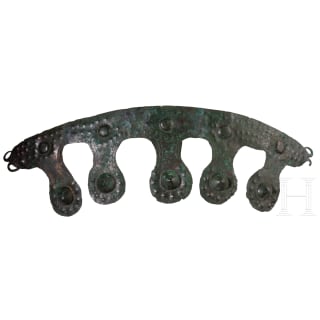
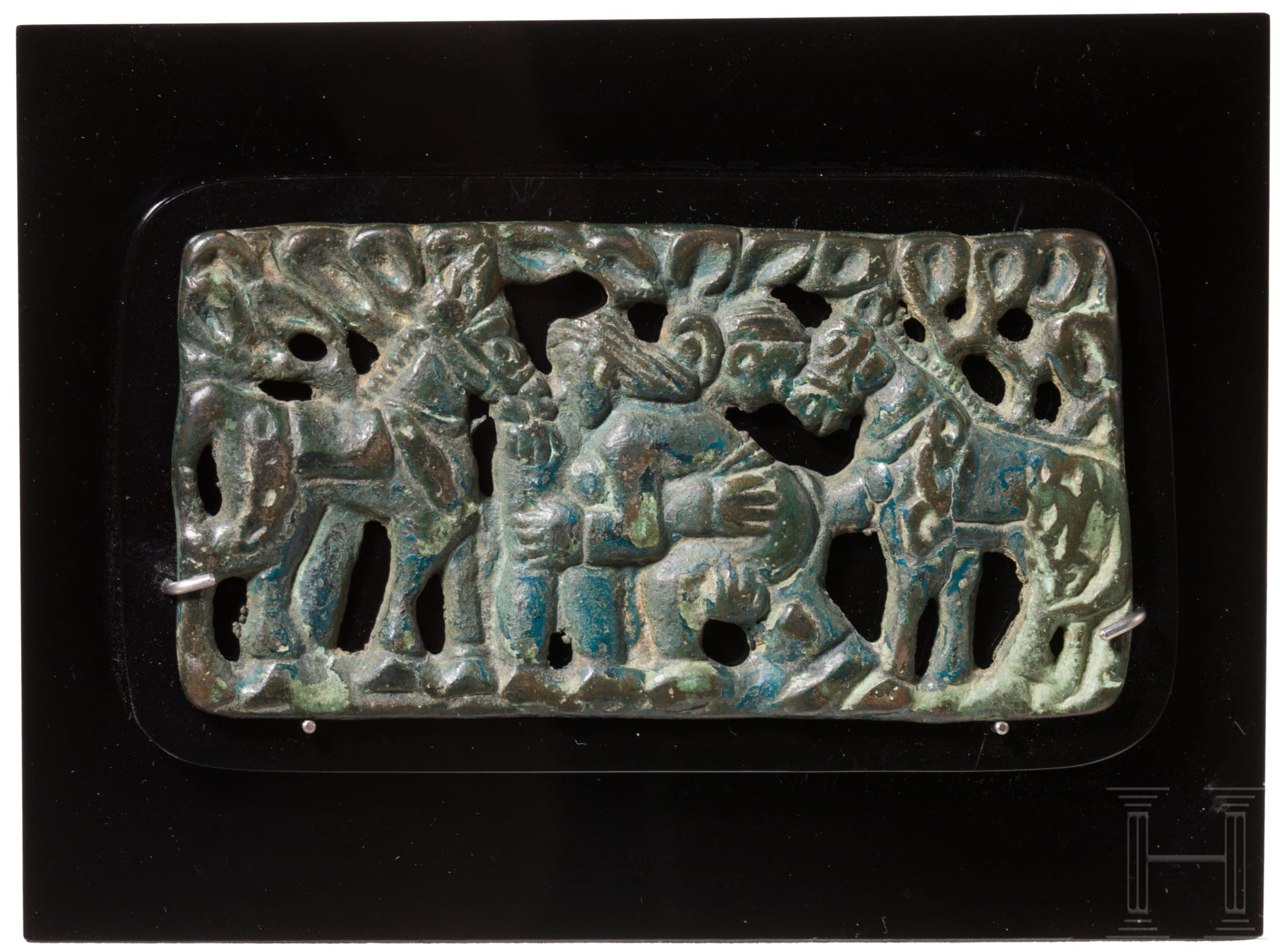
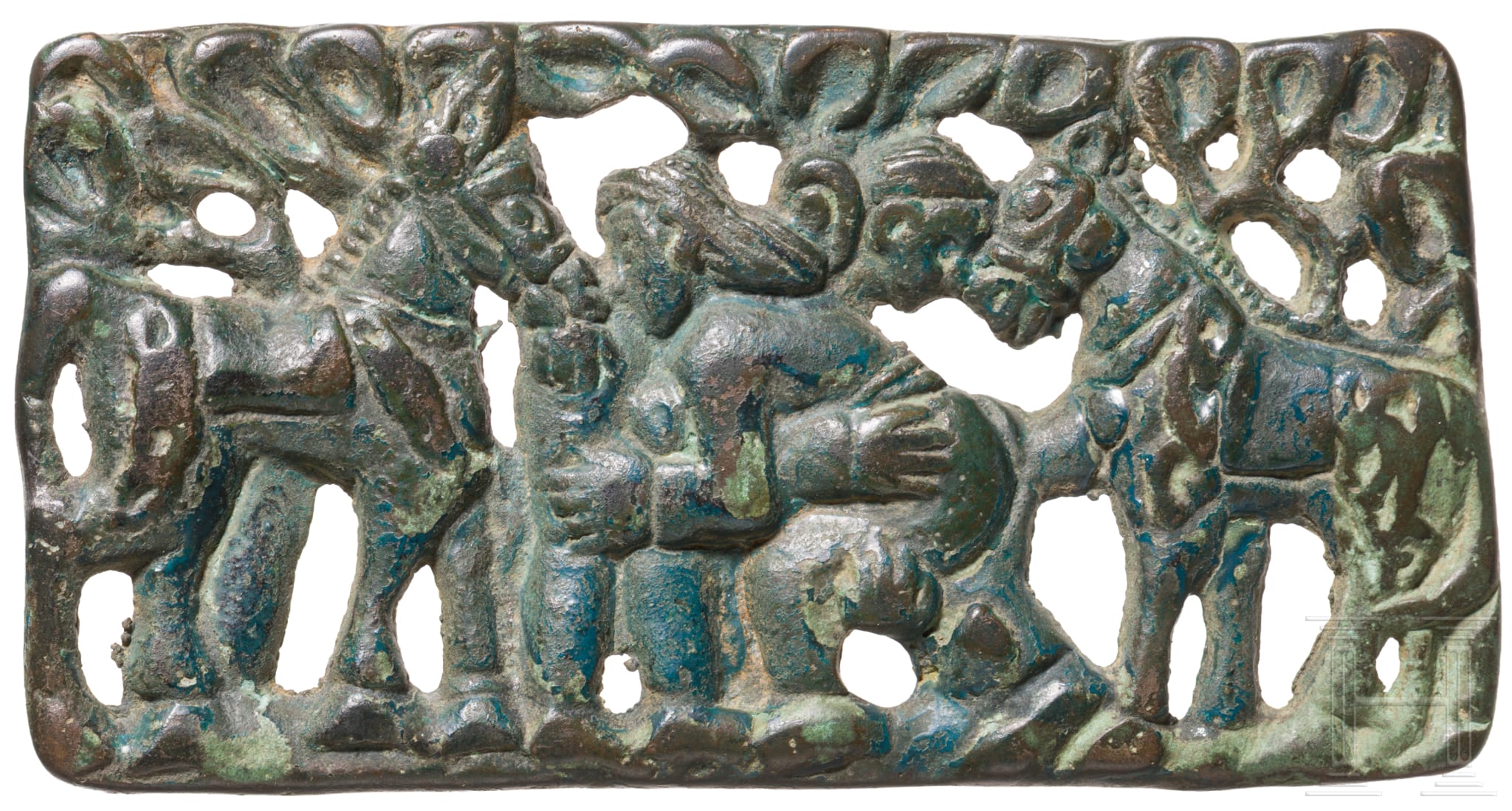
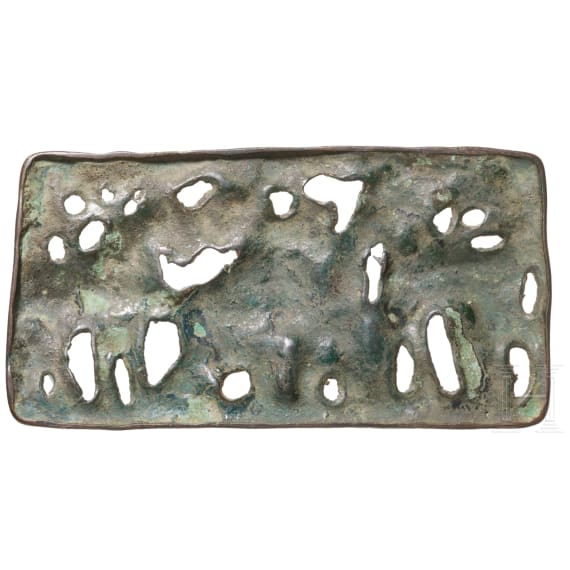
A rare nomadic horsemen’s belt plaque from the Ordos region, depicting two wrestlers flanked by horses, Mongolia, 2nd–1st centuries B.C.
Works of Art, Antiquities & Ancient Art | A109kua | Live auction | 1190 Lots
Description
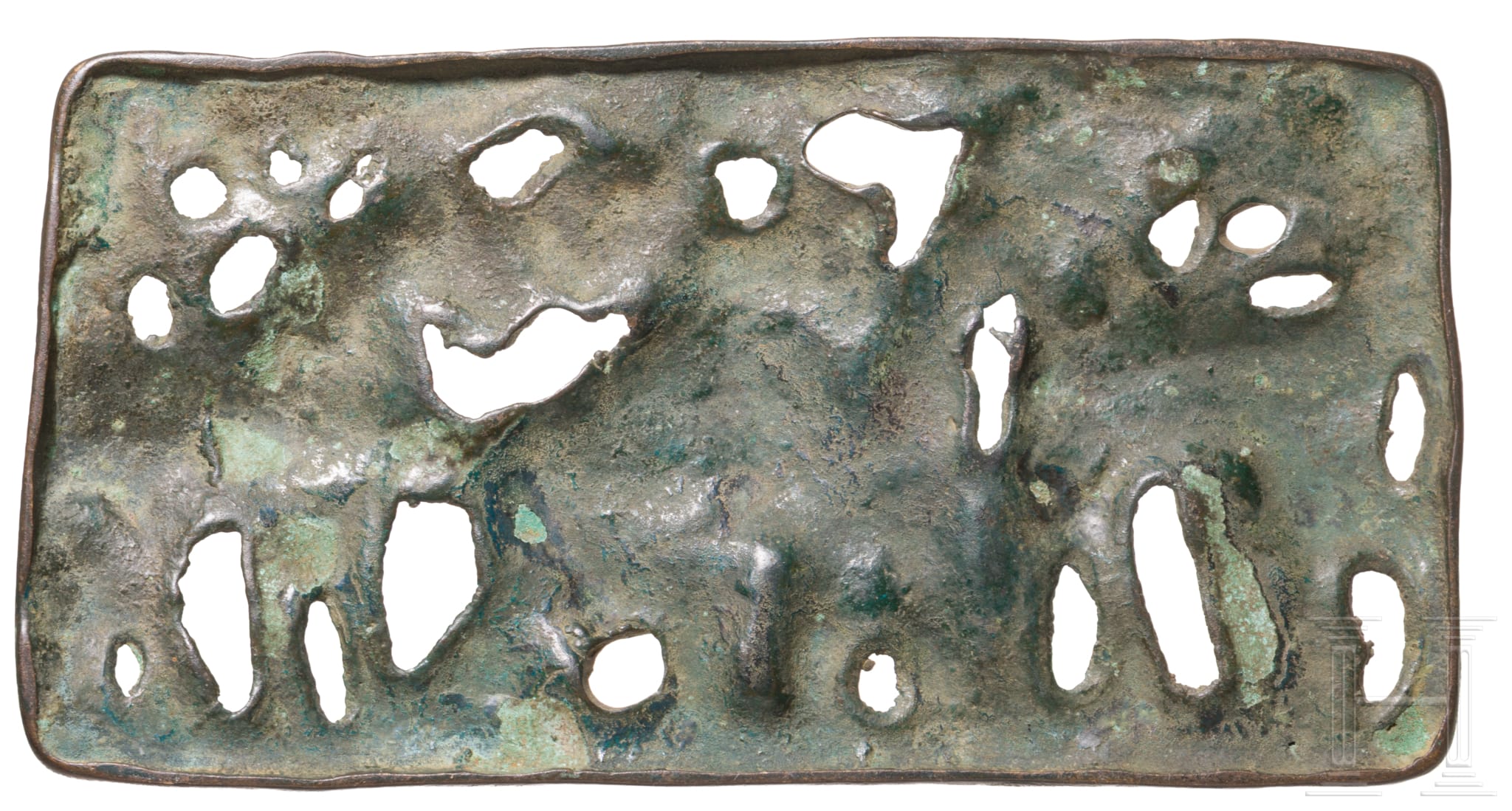
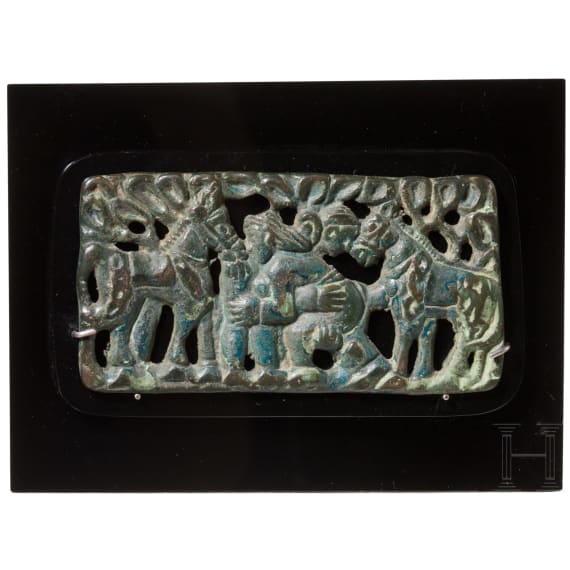
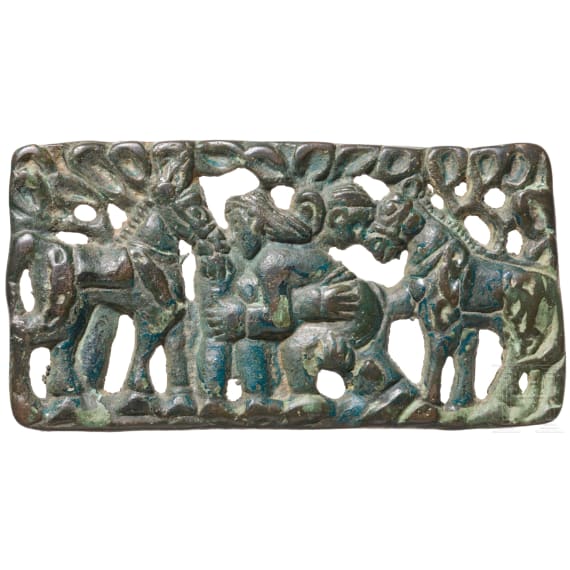
On the sides of the plaque two inward-facing, bridled horses with saddle and lavish decorated harness, standing before trees whose branches and leaves spread out behind the horses towards the upper border and meet in the centre. Between the two horses two intertwined wrestlers. The clean-shaven man standing on the left has bent his upper body down to the right with his legs still slightly extended. From the right, a second wrestler with long hair and beard, in a deep kneeling position with his right leg extended backwards, attacks the left wrestler from diagonally below. With his left hand he grasps the right thigh of his opponent, with his right he encircles the opponent's upper body and reaches from the left onto his right hip. The left combatant grips with his right hand, passing under his attacker's upper arm, the attacker's left hip and from below through his legs to the bottom and flank of the left thigh. The aligned hooves of the horses and the feet of the wrestlers rhythmically articulate the lower border of the plaque, finding its counterpart in the alignment of leaves along the upper border. The balanced composition represents a masterpiece of steppe-nomadic minor sculpture from the last centuries before the turn of the era. At the same time, the mounting is a representative of an iconographic type that, in identical composition with subtle differences in quality and stylistic execution, is displayed on individual mountings in leading museums around the world as showpieces of steppe-nomadic art (e.g. in the British Museum, the Ethnologisches Museum in Berlin, the Shanghai Museum and the Museum of the Archaeological Institute in Ulan Bator). A type-identical example with variations in detail was sold at Sotheby's in 2019 (Arts of Ancient China II, lot 216) for US $12,500. This plaque type is associated with sites from the sphere of influence of the Xiongnu mentioned in Chinese sources. Already the first Emperor Qin Shihuangdi launched offensives against this tribal confederacy, which continued into the time of the han dynasty. The russian scholar Grjasnov connected the scene with episodes from heroic epics of modern Turkic peoples of Central Asia, whose origins he believed he could trace back to the 8th century B.C. To this day, wrestling contests are among the three disciplines in which a man should distinguish himself: riding, archery and wrestling. The plaque may thus stand iconically for the values of Eurasian steppe nomads. Partially minimal ancient abrasion, above which a fine green Patina with bluish spots. The bottom worked hollow to conserve material. Intact. 11.2 cm x 5.9 cm. Removably mounted on a representative Plexiglas base. CULTURAL ASSET!Provenance: Private collection in Germany; acquired in 2021 on the British art market.
Condition: I - Questions about the lot?