




Lot 940
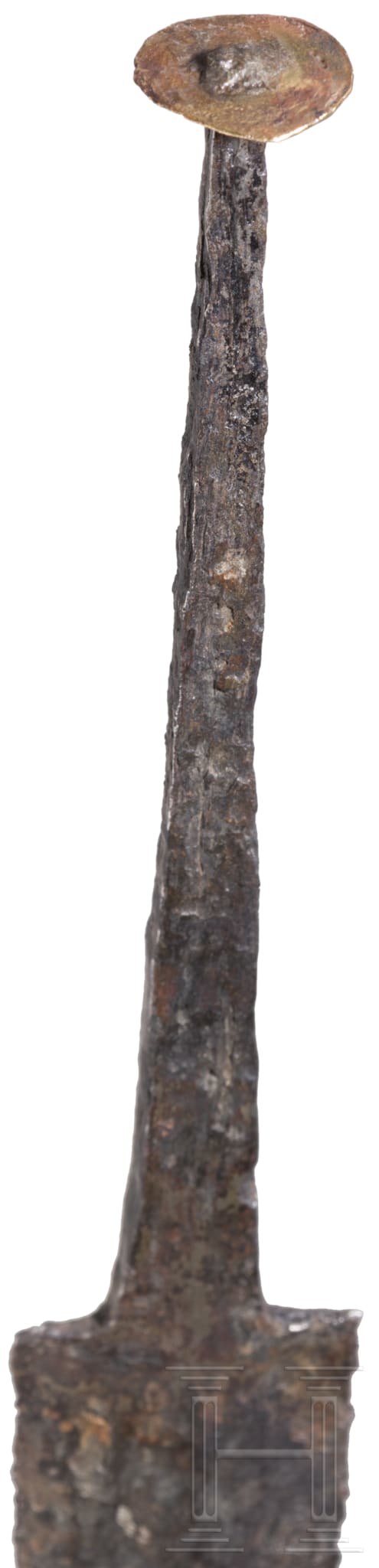
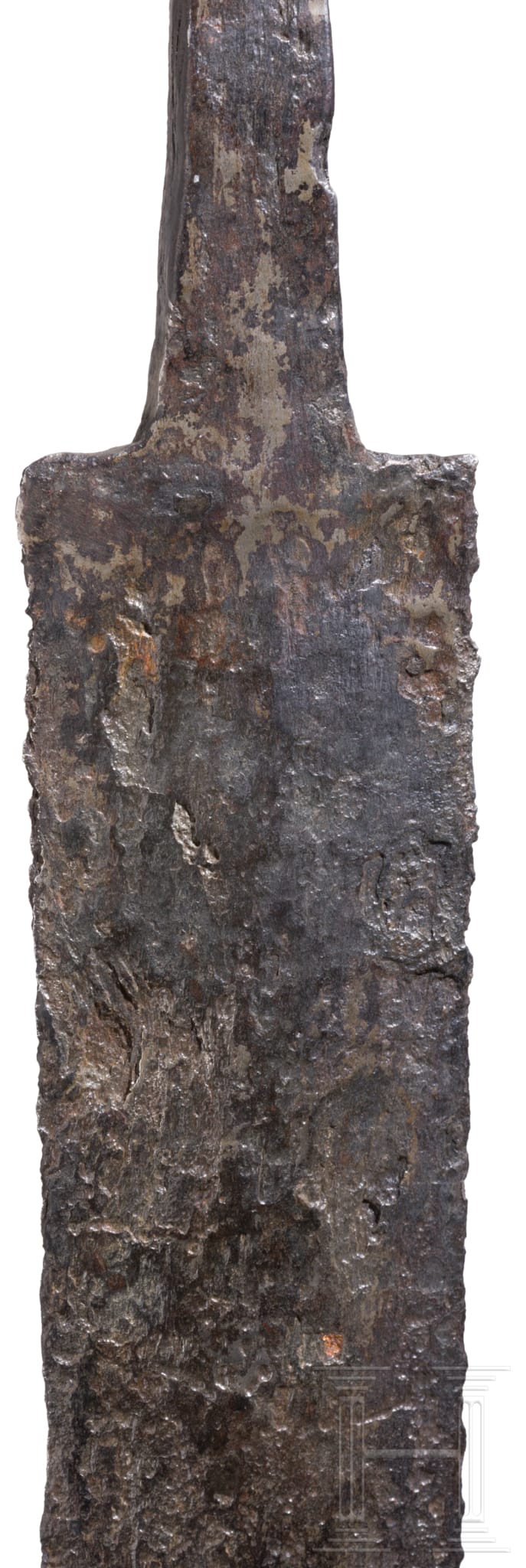
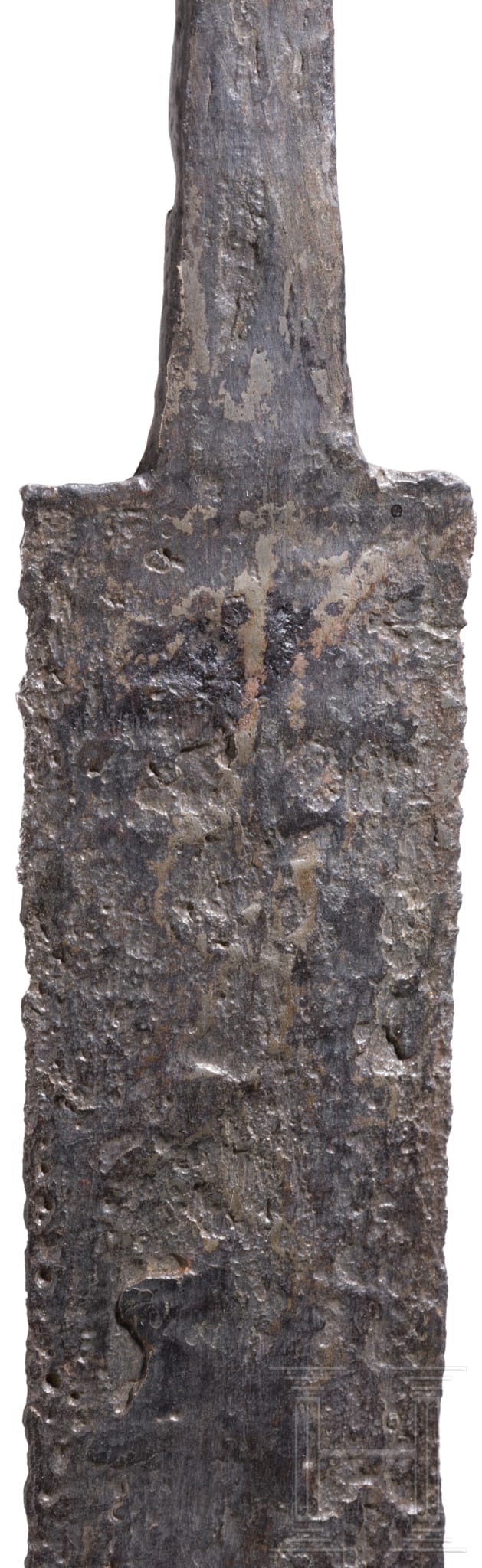
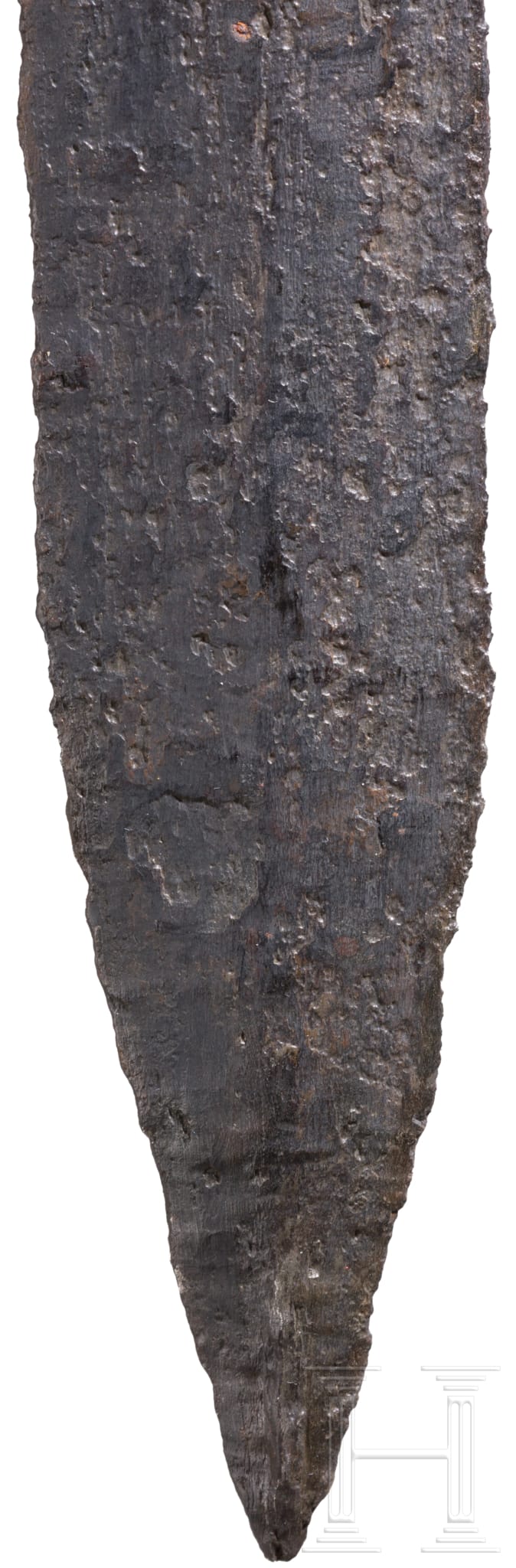
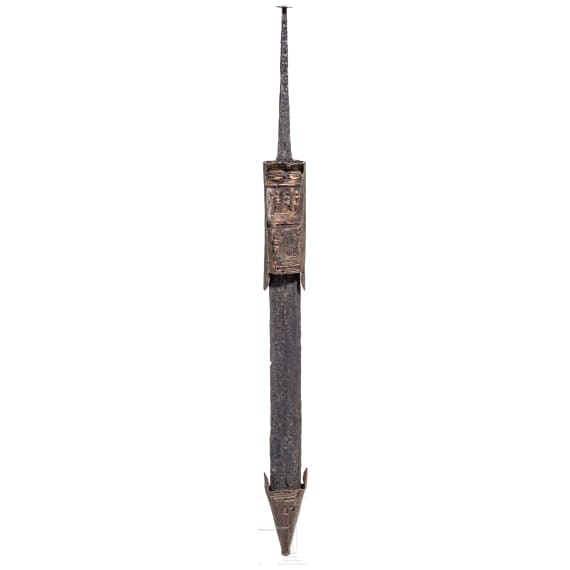
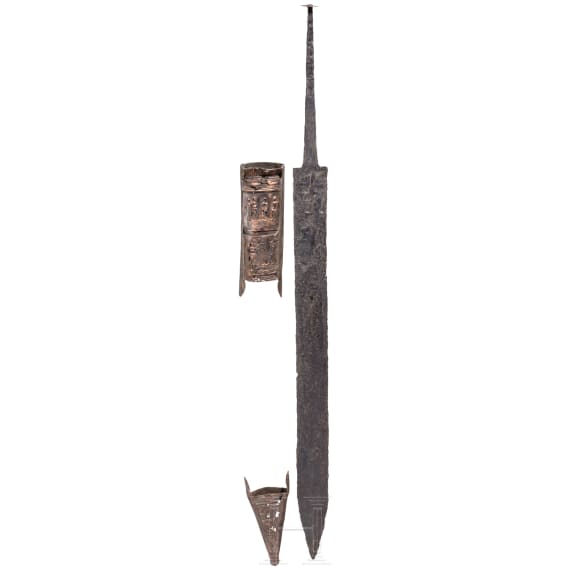
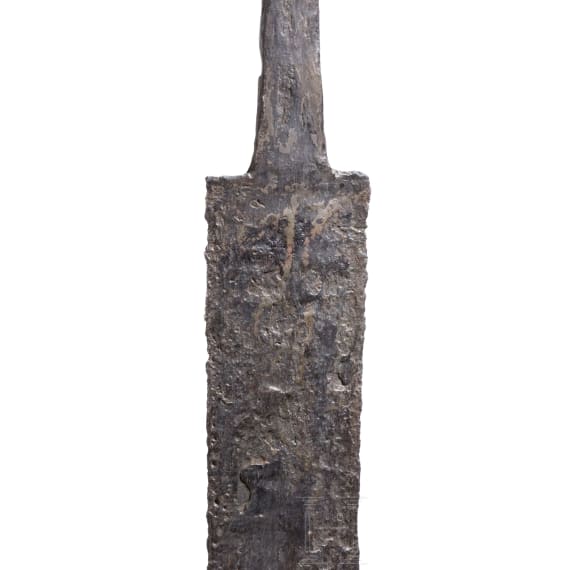
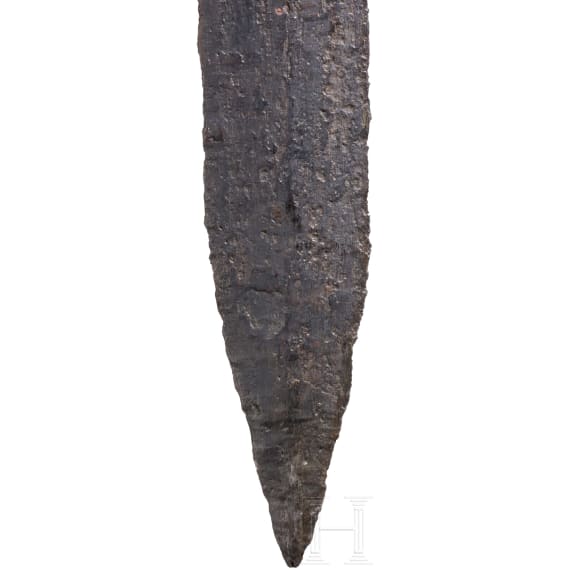
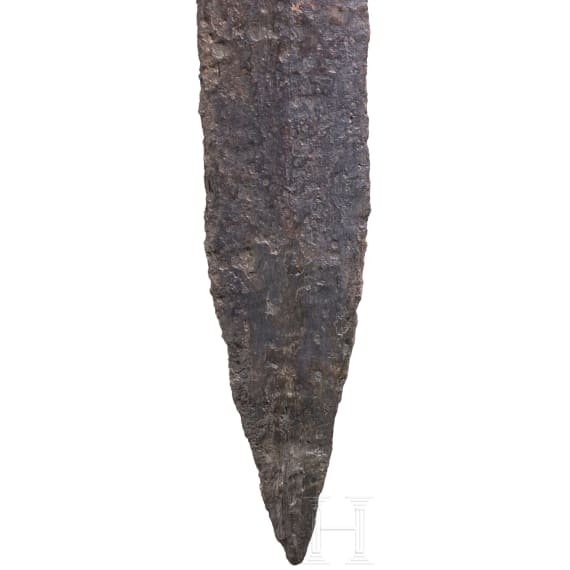
A Roman gladius of the Pompeian type with scabbard fittings, second half of the 1st century A.D to the early 2nd century A.C.
Works of Art, Antiquities & Ancient Art | A109kua | Live auction | 1190 Lots
Description
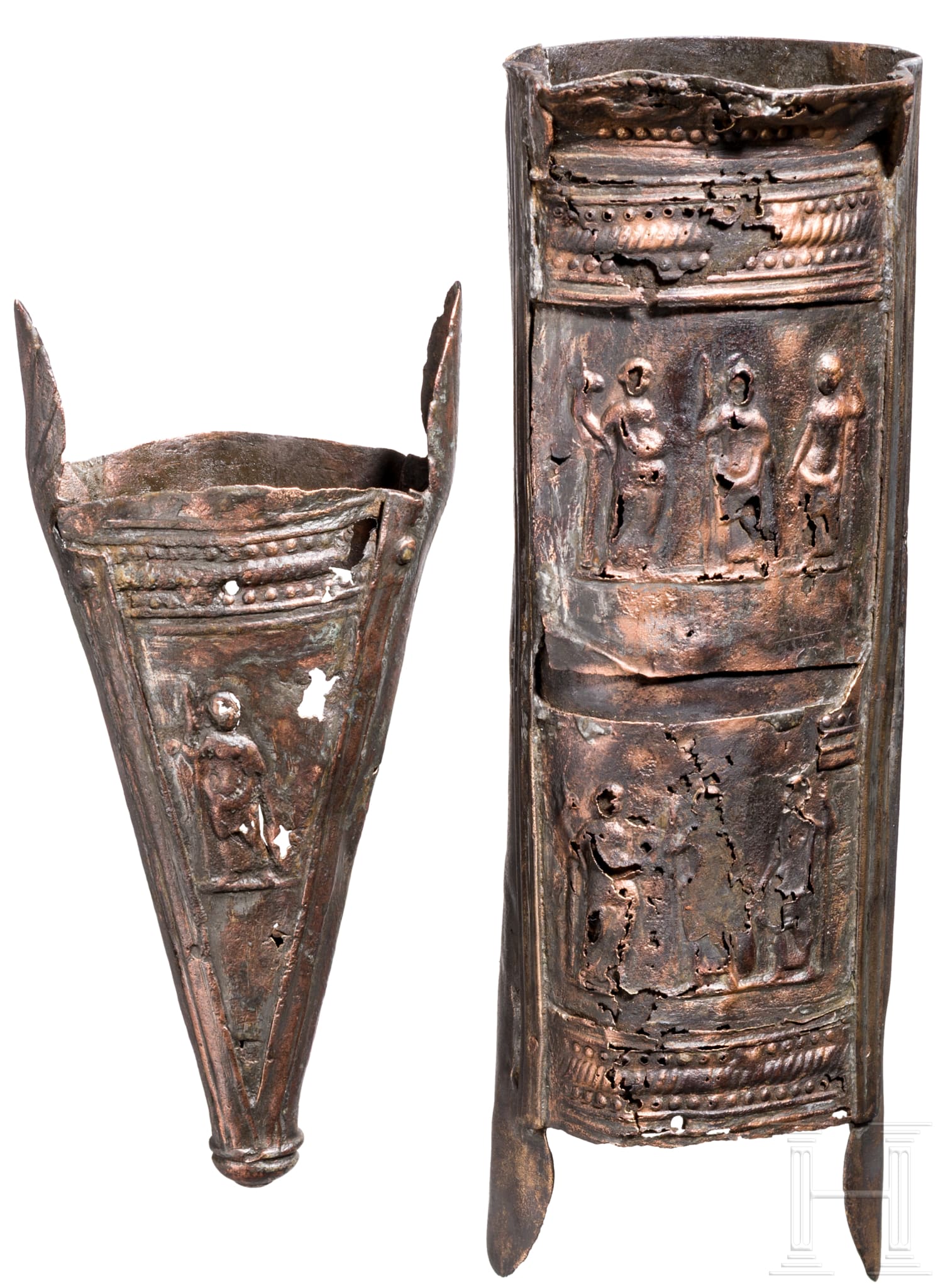
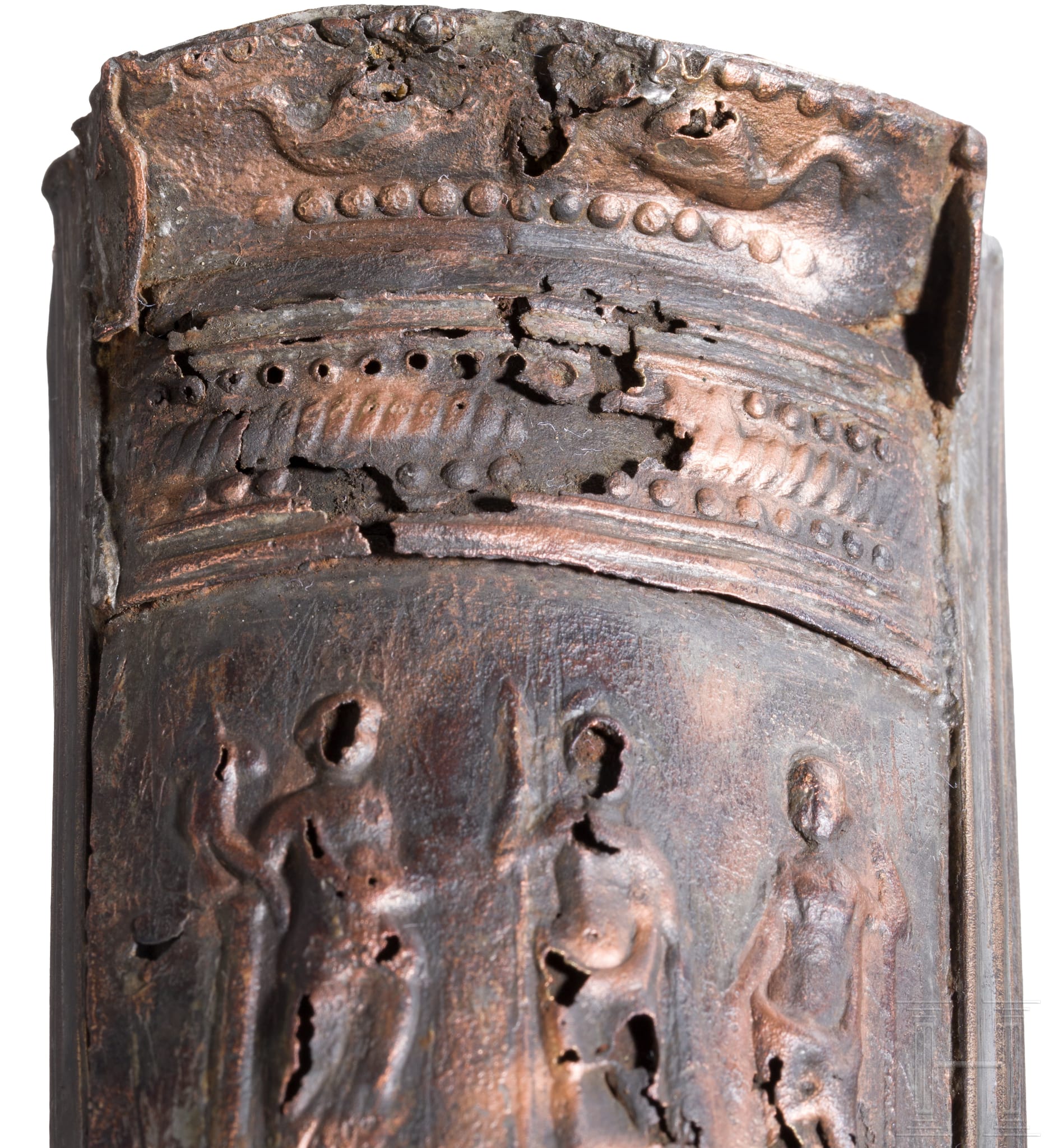
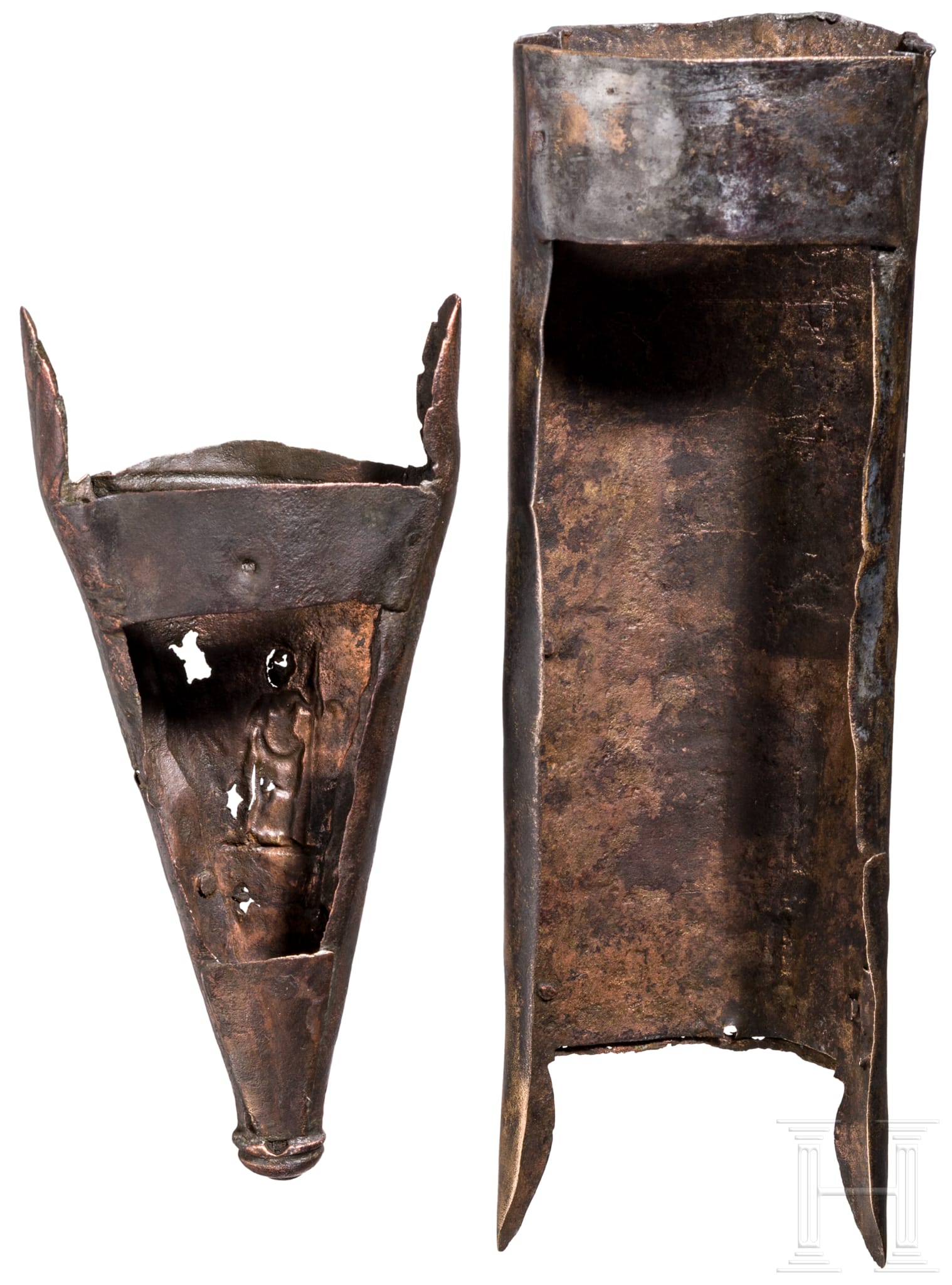
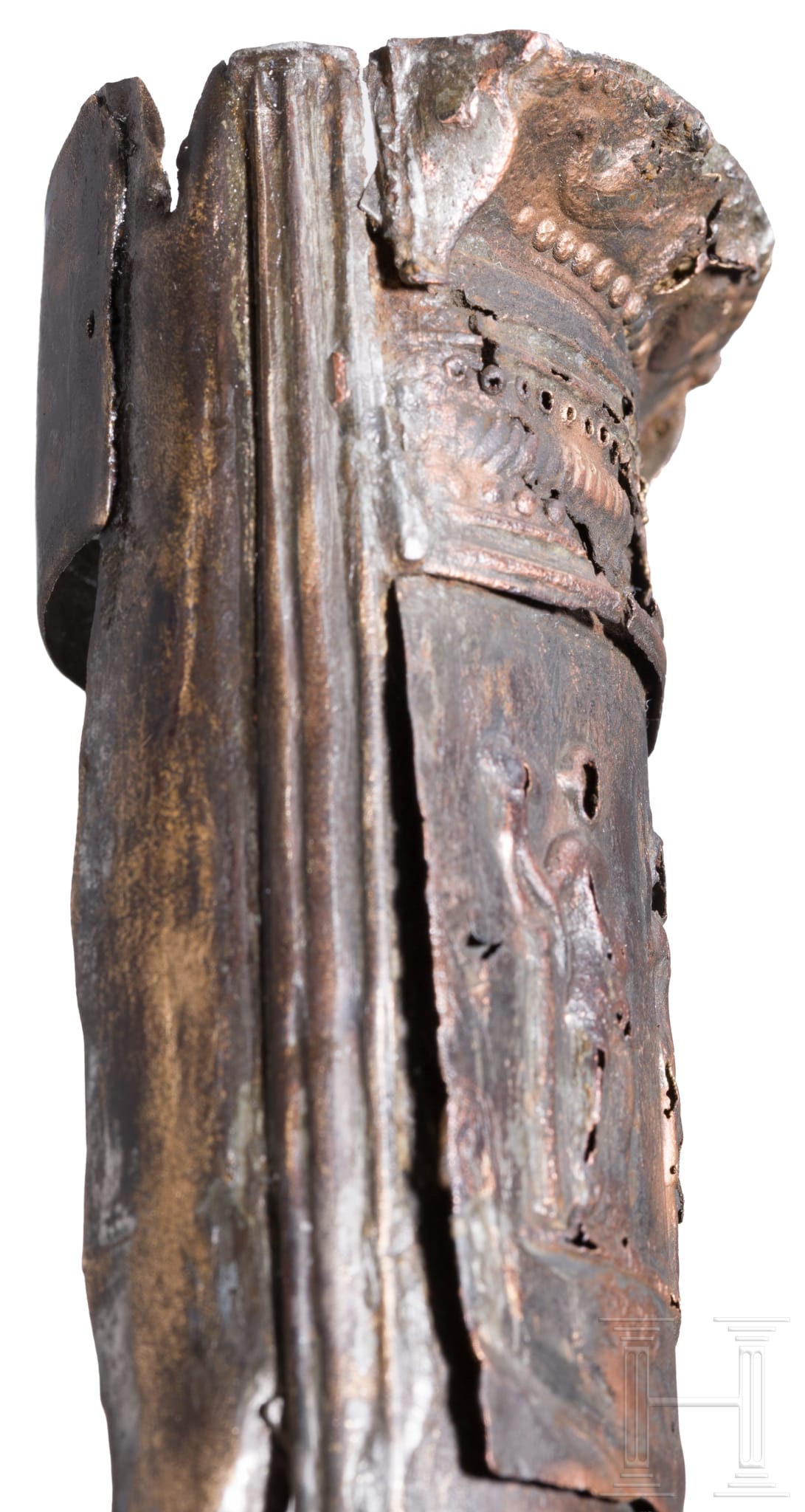
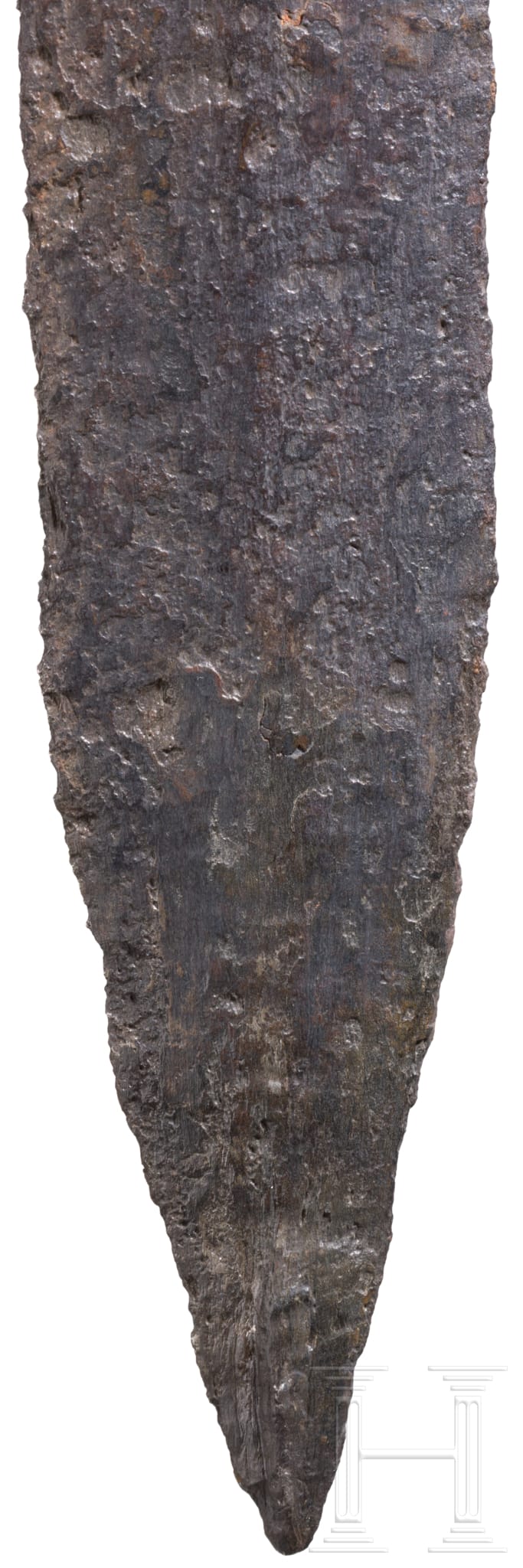
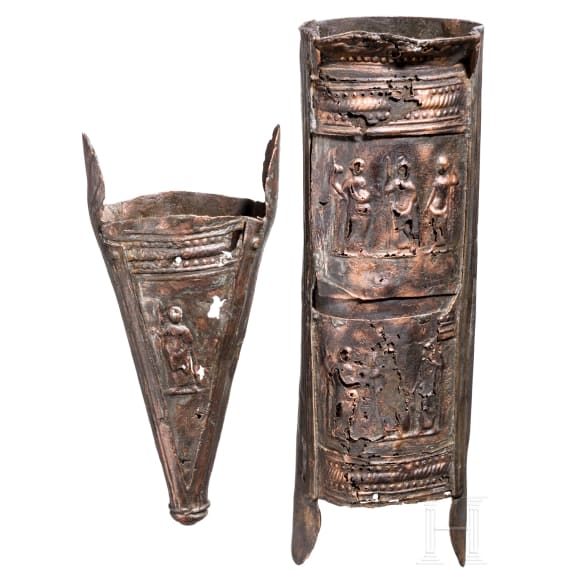
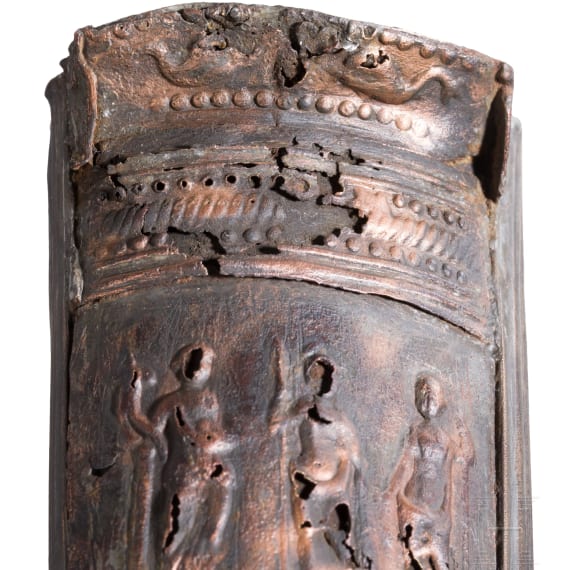
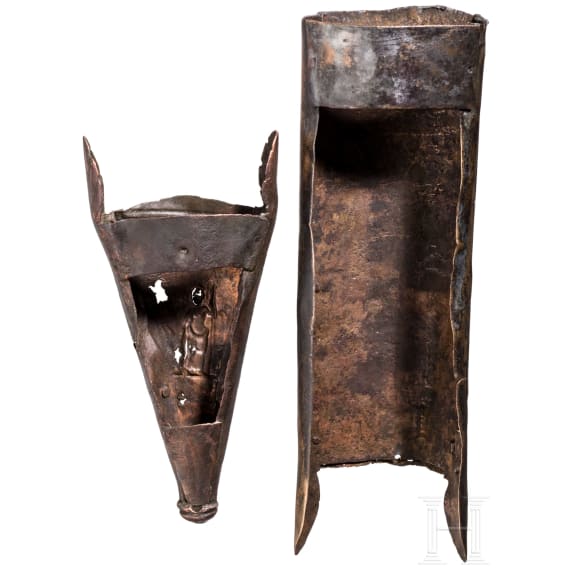
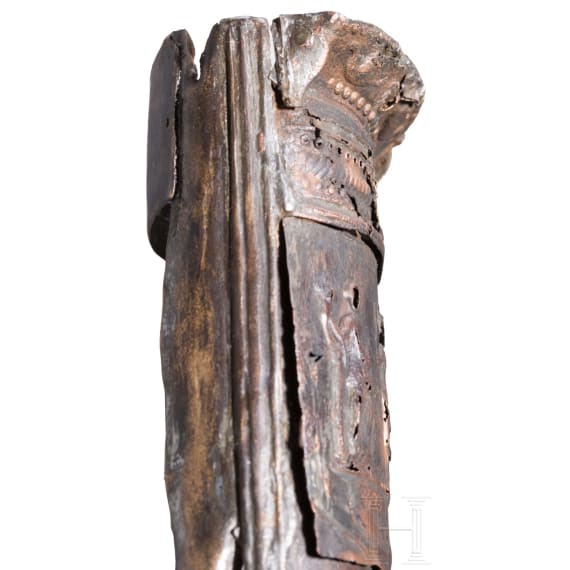
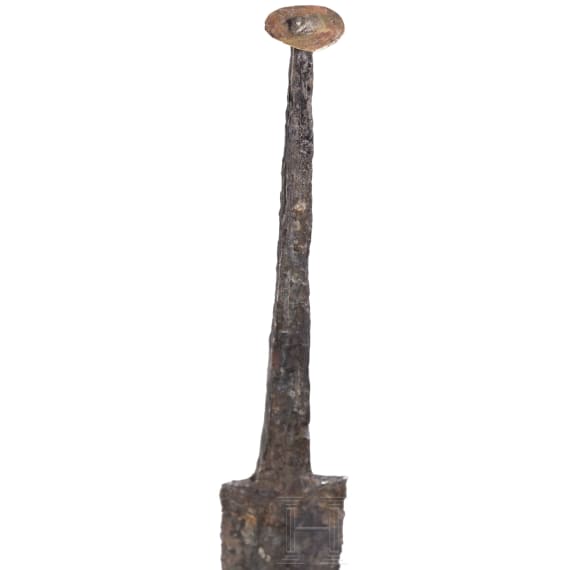
A short sword with parallel, straight cutting edges and a triangular tip. The 4 cm blade joins the 17.8 cm long tang – which has a rectangular cross-section – at the upper end at a precise right angle; the tang tapers steadily upwards, measuring 15 mm at the base and just 3 mm at the top. A 17.5 cm oval disc of bronze sheet metal is riveted to the upper end of the tang. The 48 cm blade features an obtuse medial ridge, from which the blade thickness tapers continuously out towards the cutting edges. The distinctly offset, 8 cm triangular tip is significantly thicker at the front, so that the cross-section forms a sturdy, approximately equilateral rhombus. This morphological and technical feature is found on several gladii of this type and served to pierce the enemy's armour, enabling the blade to break through the rings of chain mail or to penetrate the gaps in scale armour or plate armour more easily. The surface of the blade shows slight rust pitting with minimal notches on the cutting edges. Overall, a very well-preserved piece that clearly reveals the weapon's characteristic outline. Expertly conserved and stabilised. Total length of the blade: 65.8 cm. It is accompanied by a hilt strap and a copper scabbard ferrule, both showing clear traces of tin plating on parts of the surface. The chap, measuring 11.7 cm in height and 5.5 cm in width, is composed of eight riveted sheet metal parts: 1–2) Two curved side strips that taper at the top into two palmette motifs, which frame the straight section of the scabbard at the bottom. At the bottom is a hemispherical, hollow decorative knob, profiled at the rim, into which the converging side strips are soldered. On the front, a triangular pressed metal plate has been inserted, which has been embossed with a design using a mould. At the top is a decorative band, a ‘cord’ with diagonally running, intertwined strands, bordered at the top and bottom by a row of dots, followed by a double line. In the centre, on the base, is the goddess Minerva with a spear and shield. The edges of the side strips and of the stamped metal plate fixed to them by soldering are additionally covered on both sides with a profiled metal strip, which is also riveted at the top to the underlying metal plates. On the reverse, below the palmettes, a strip of sheet metal (1.5 cm wide) is soldered to the side strips and additionally riveted at the edges. In the centre of the band is a rivet hole for attachment to the wooden wall of the sword scabbard. The tip of the hilt band is covered on the reverse side by a small triangular sheet of metal, which is soldered only to the strips and the decorative knob. The centre is open. The thoroughly cleaned surface reveals, alongside traces of tin plating, the copper-coloured surface of the alloy used in many places. There are small holes in the stamped sheet metal and a crack in one of the side strips. The locket, which is 15.5 cm high and 5.2 cm wide, has a similarly complex design. The front consists of a rectangular sheet of metal that is curved at the sides and clamps round the edge of the back of the scabbard. There are no separately crafted side strips. At the bottom, the corners of this metal clamp taper out at the sides into spoon-shaped ends that extend down over the surface of the upper side. However, these ends are not designed as palmettes, as is the case with the hilt guard. On the reverse side, the hilt guard is again finished off by a metal strip (2.3 cm wide) that is soldered to the side strips and additionally riveted. Towards the bottom, the mouthplate remains open on the reverse side. At the mouth, the sheet metal is slotted at the sides and the edge on the front face has been bent outwards to facilitate the insertion of the blade into the scabbard. Small, profiled triangular metal plates are soldered and riveted to the sides to cover the slits. A stamped metal plate is soldered onto the pre-bent mouth of the scabbard; it is decorated with two opposing dolphins between rows of dots. In a subsequent step, two approximately square stamped metal plates with identical imagery were soldered onto the large metal clamp. These depict a triad of deities: in the centre, Minerva with a spear and shield; to the left, a goddess leaning against a column, holding a cornucopia in her bent right hand and fruit in the fold of her robe with her left. The right-hand figure holds a sceptre in her right hand and an object in her left (a rudder?). The edges of these decorative plates are covered with three pressed metal strips, the decoration of which is identical to that on the strip on the base band: a ‘cord’ pattern, bordered by rows of dots and double lines. Only remnants of the middle strip remain; the upper strip also covers the edge of the strip featuring the dolphins. The three panels with the ‘cord’ motif are soldered to the base. The vertical edges of all the decorative panels are covered at the rim by two 13.2 cm long, profiled metal bands. These are soldered and additionally secured with rivets, which pierce through the three panels with the ‘cord’ motif at their ends. The surface is similar in texture to the hilt band, with smaller perforations, particularly on the raised relief areas. At the level of the two lower ‘cord bands’, there are slits to the left and right behind the profiled metal strip; these were used to thread through metal strips in which small rings were attached for suspending the scabbard from the sword belt. However, these elements are not preserved here. Overall, a very fine example of a classic Pompeii-type gladius with very well-preserved ironwork and representative ‘Pettau’ style scabbard fittings. CULTURAL ASSET!Provenance: From a private collection in southern Germany. From the estate of the consignor's grandfather, who assembled a specialised collection focusing on prehistoric and early historical weapons during the 1960s and 1970s.
Condition: II Questions about the lot?