

Lot 1076
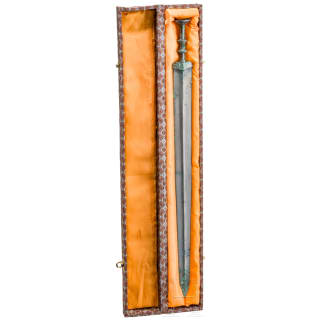
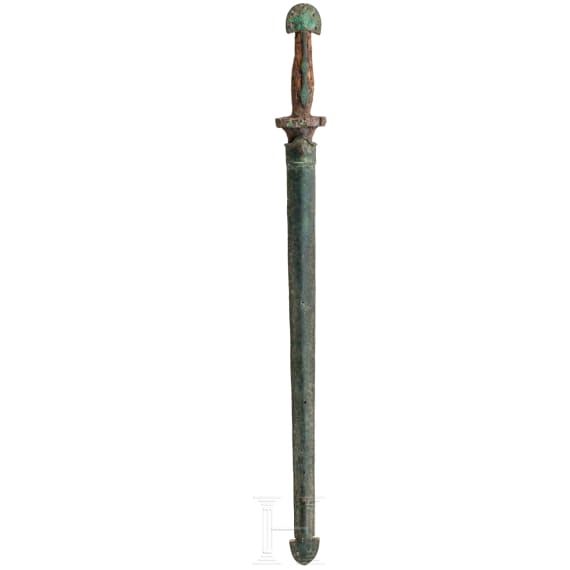
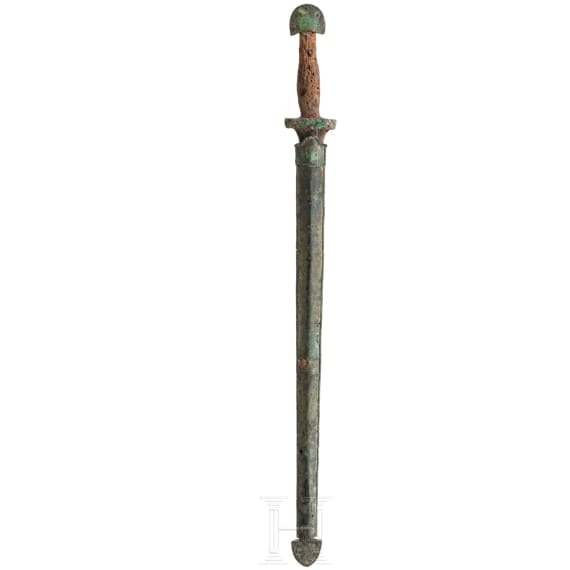
Replica of an ancient Italian hoplite sword, circa 1900
Works of Art, Antiquities & Ancient Art | A109kua | Live auction | 1190 Lots
Description
The shaped hilt with bulging sides, the crossguard and the shield-shaped chape (derived from a pelta-shaped chape) are intended to represent an iron hoplite sword with a bronze scabbard. The stylistic and technical features are not implemented with complete consistency or expertise. The offset mouth of the scabbard at the upper border does correspond to similar fittings on the scabbard of original hoplite swords. However, the bell-shaped terminal of the scabbard, as well as the button on the reverse, are inspired by Celtic swords of the Middle La Tène period. The same applies to the folding over of the scabbard plate on the front from the back. The bell-shaped terminal of the scabbard has no counterpart in a bell-shaped crossguard as found on Celtic swords, and thus does not form a logical conclusion. The blade, which is drawn in at the top directly below the crossguard, again corresponds typologically to the blade of hoplite swords. The lateral bone inlays at the chape and pommel are likewise inspired by hoplite swords, but lack the refined ornamentation, as the inlays are visible only at the edges. The front and back are faced with closed, flat plates without openwork, which do not correspond to the complex design of the chapes and scabbard mouths of hoplite swords. To the layman, the piece does convey the impression of a high-quality and unusually well-preserved find. The Patina, corrosion and holes in the scabbard are convincingly rendered. To the specialist, however, the piece is betrayed by its mixture of elements from different cultures with technically and stylistically incompatible features that, despite a degree of familiarity with antique prototypes, are not always accurately imitated. Largely fabricated from manipulated antique components. The hilt broken off at the bottom and fitted with a pin some time ago, now re-adhered. As a piece from the Marzoli collection, it is nonetheless of interest from the perspective of the history of research. Length 94.5 cm.Provenance: Axel Guttmann Collection (estate); this piece was acquired from the L. Marzoli Collection in the late 1980s.
Condition: II - III Questions about the lot?