Lot 976
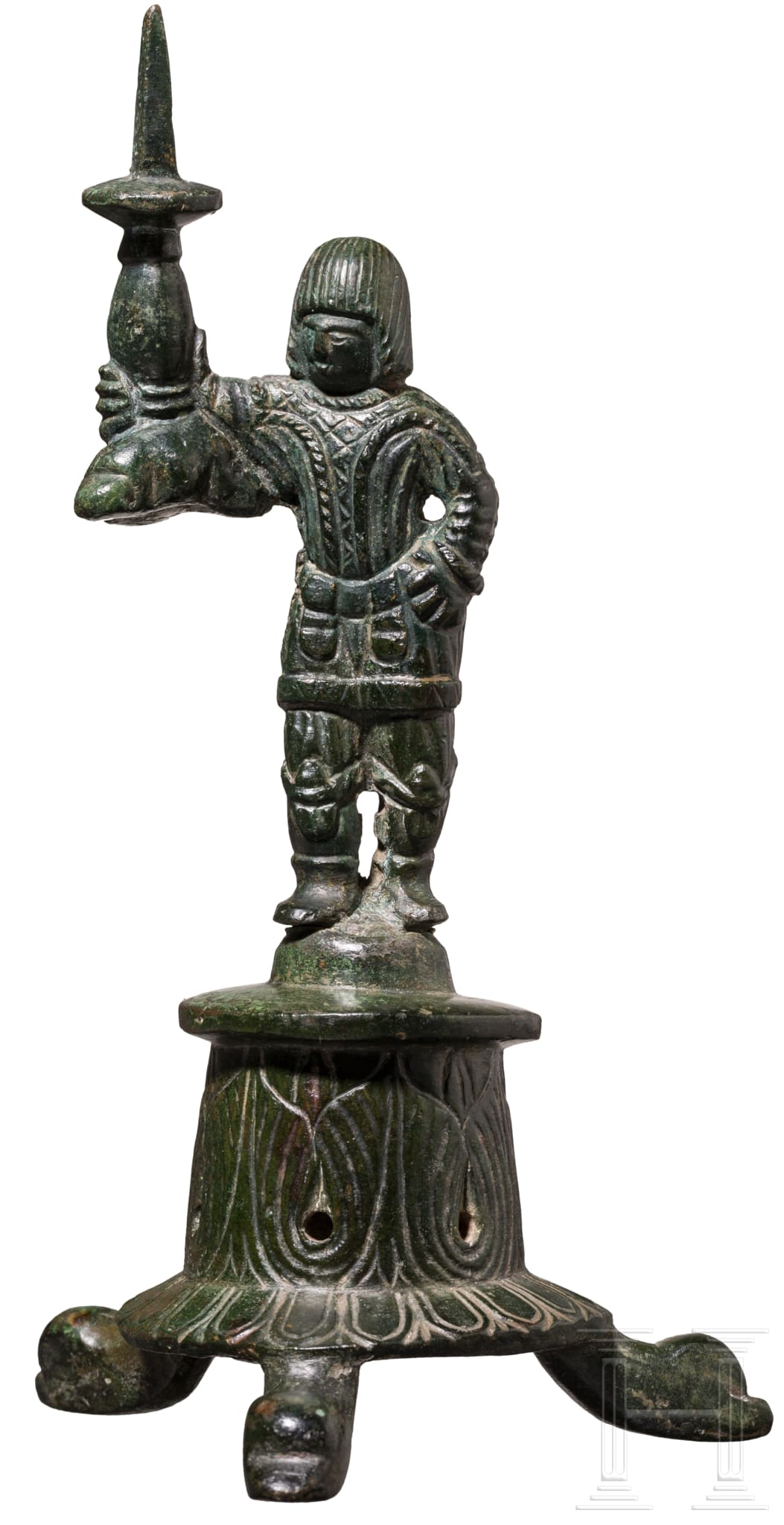
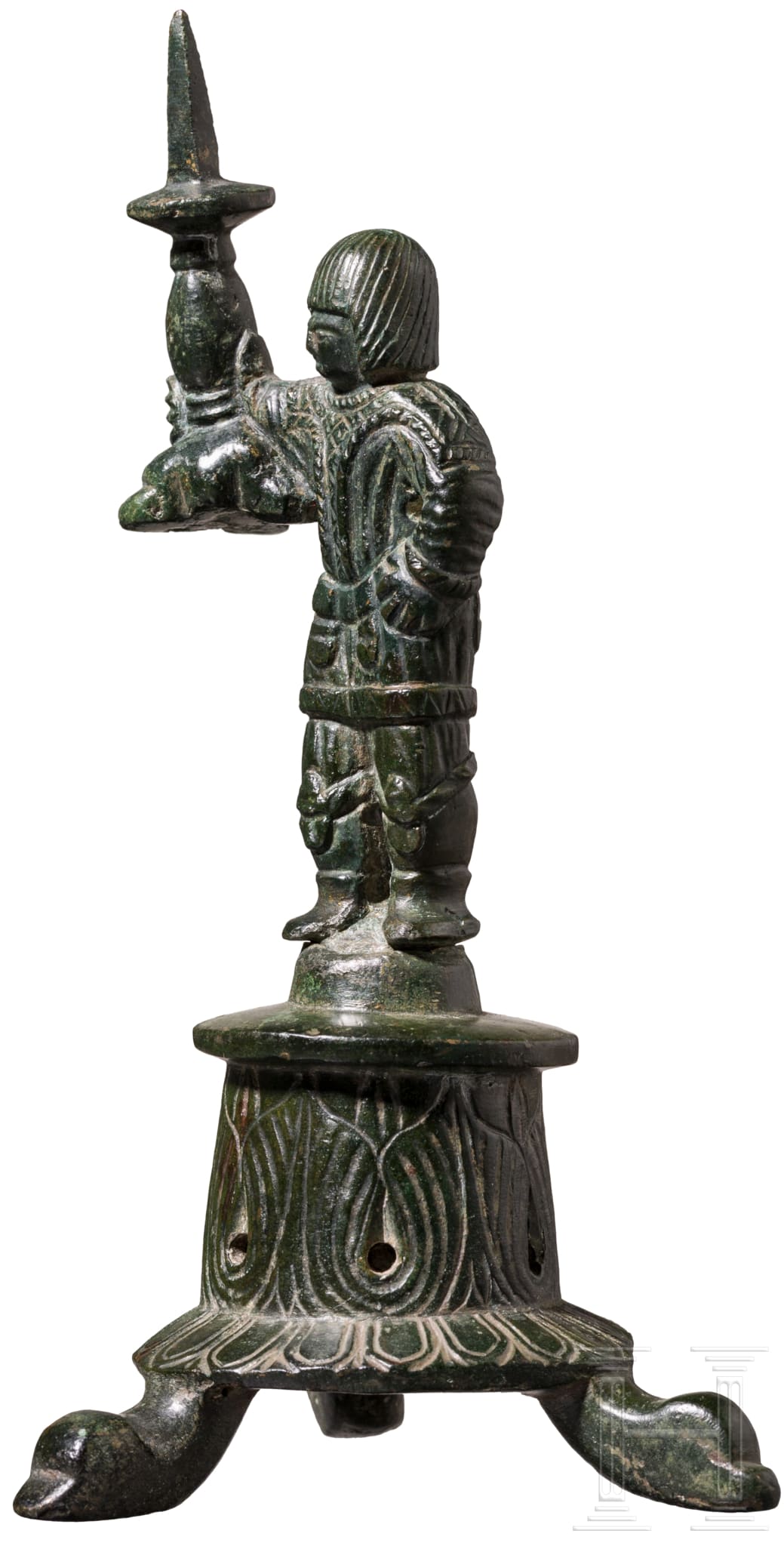
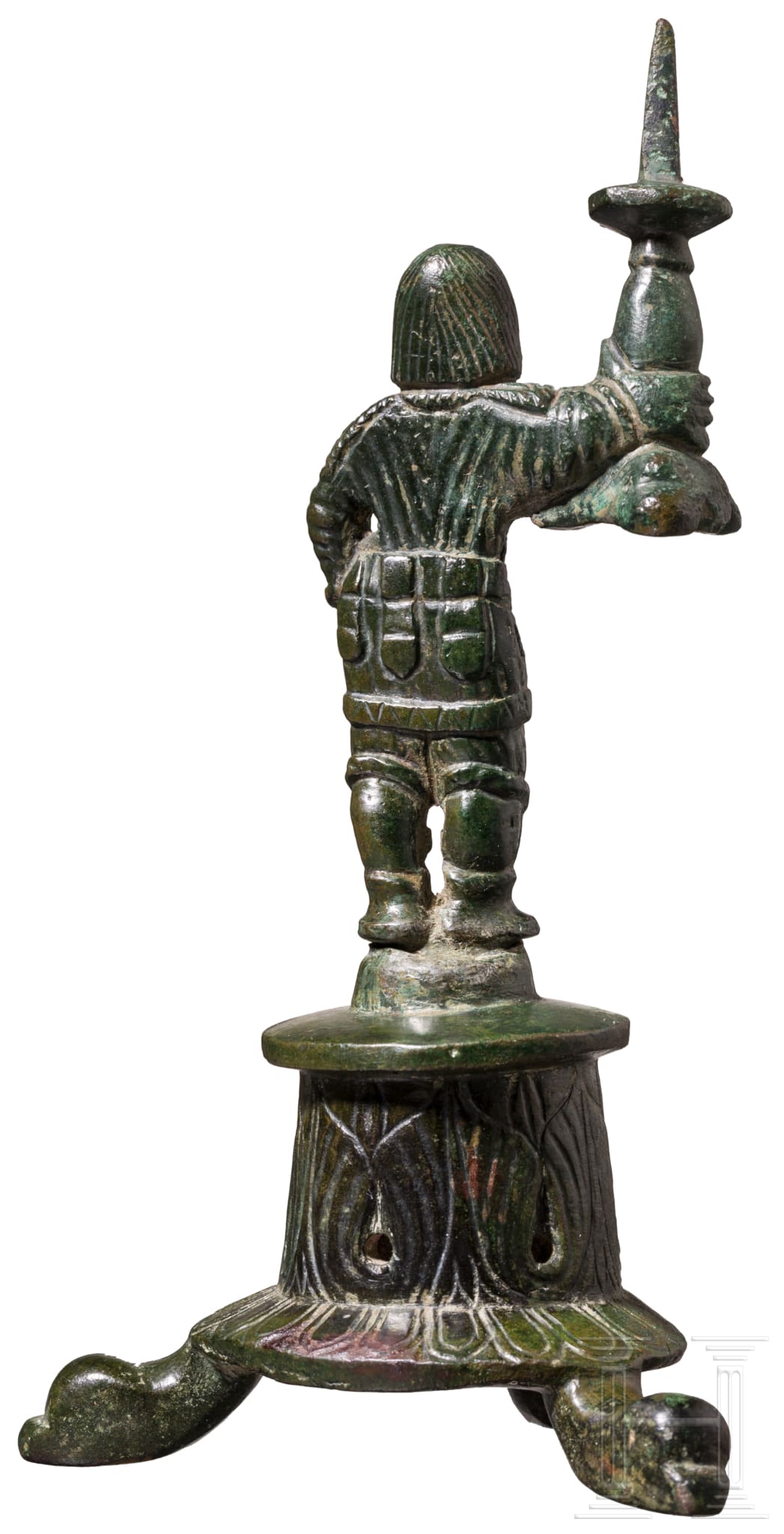
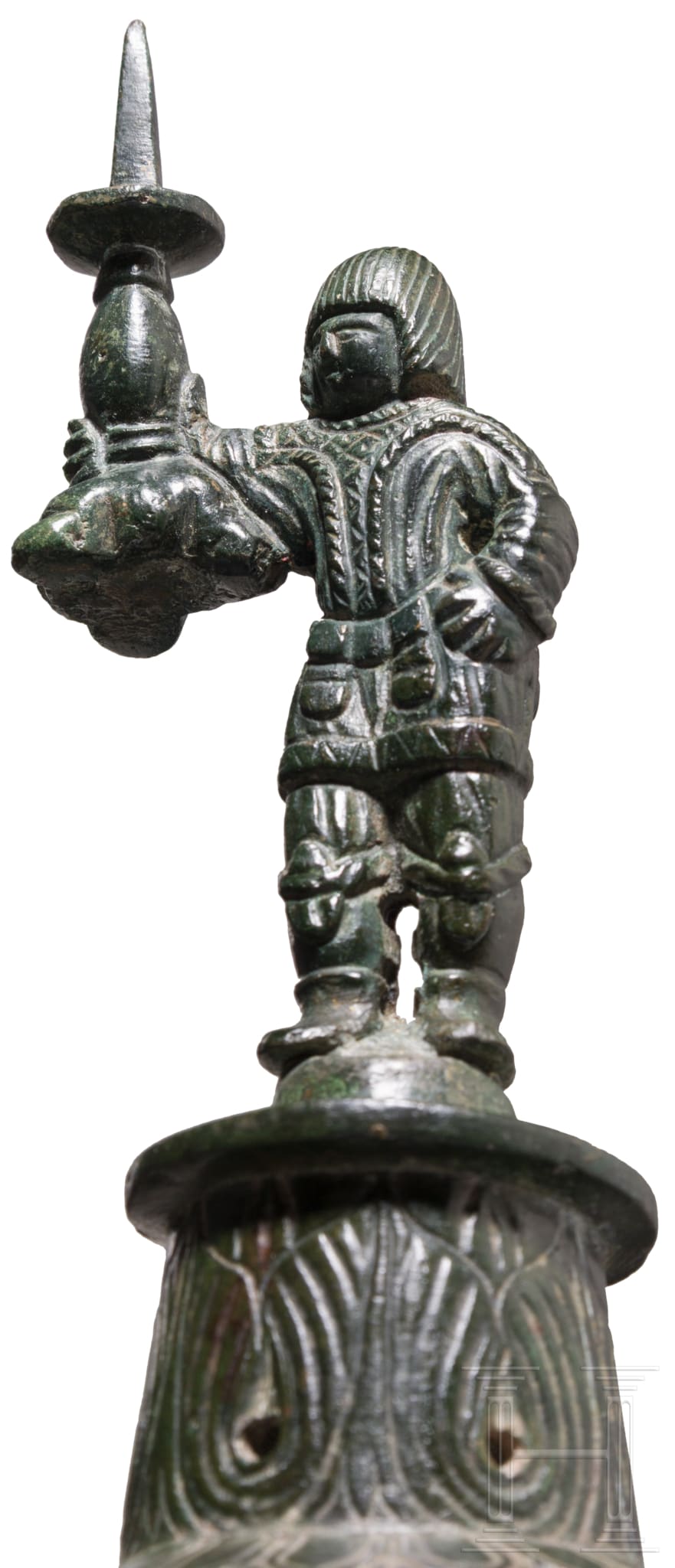
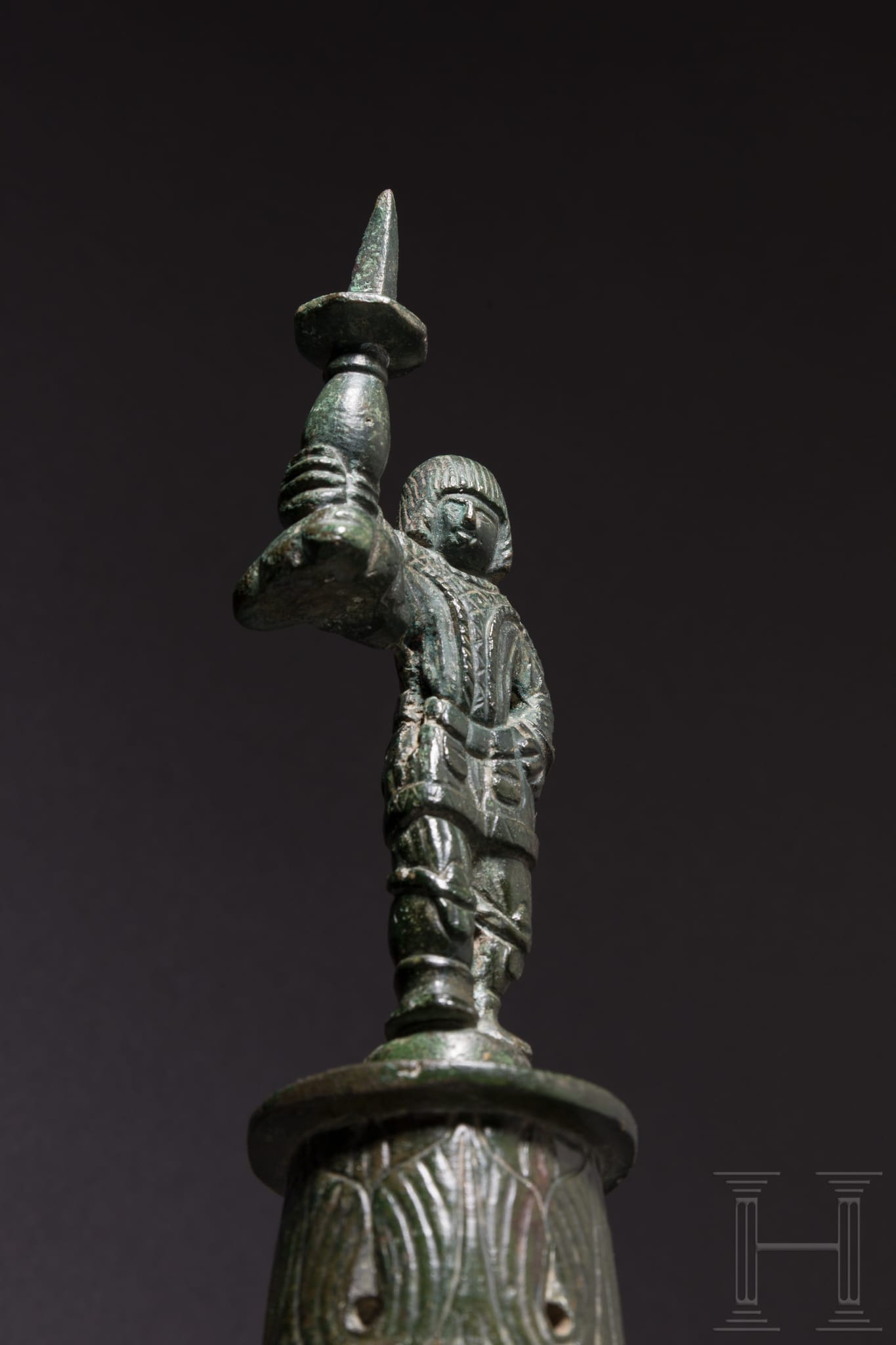
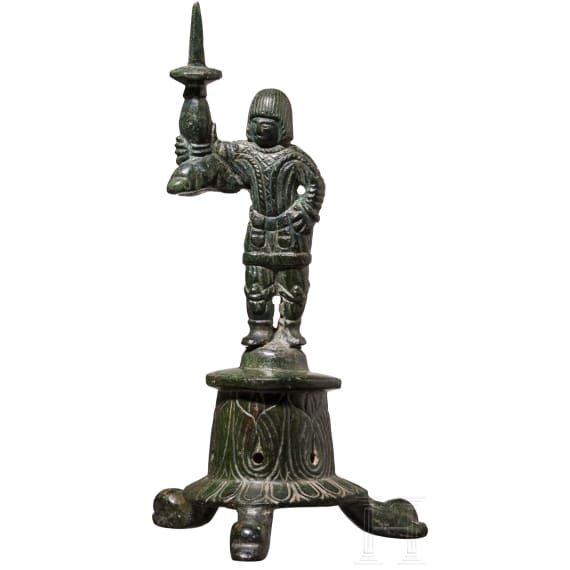
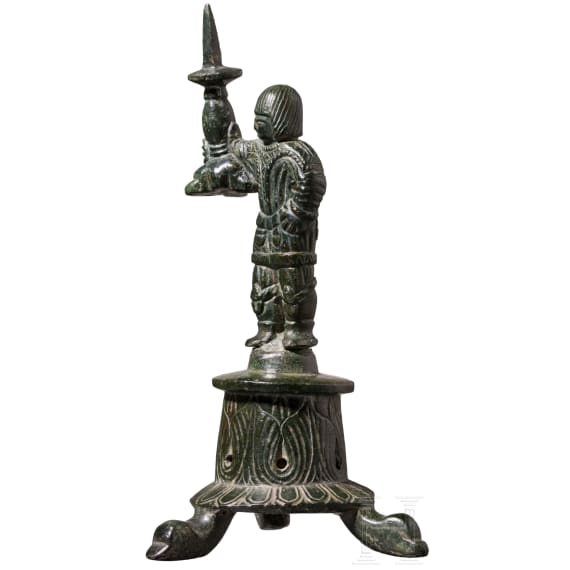
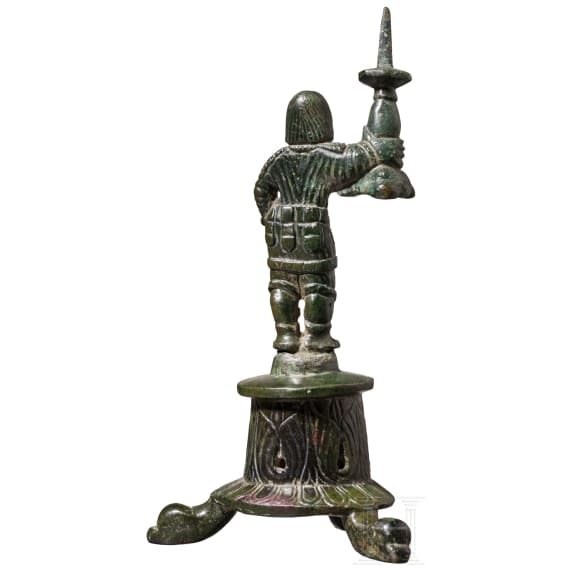
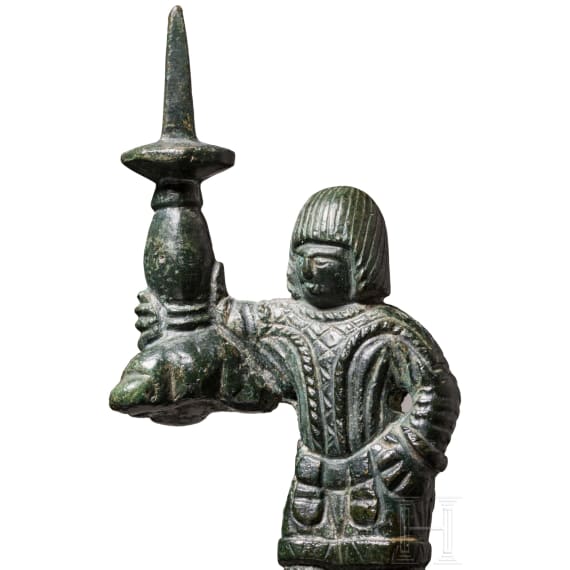
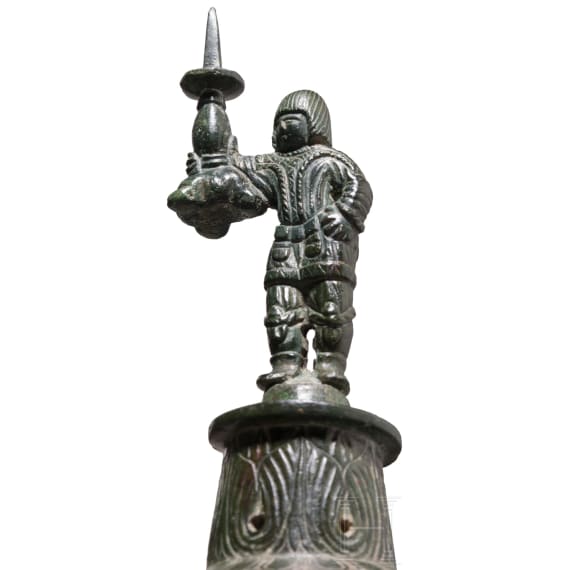
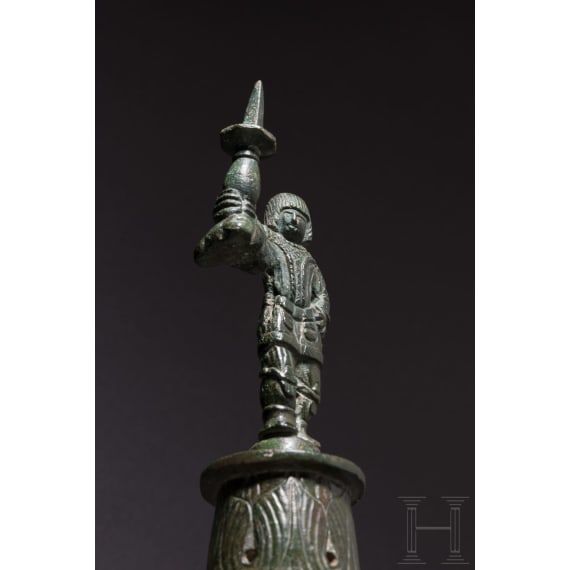
An Early Byzantine brass flambeau in the shape of a soldier with a multi-part belt, late 6th to 7th century A.D.
Works of Art, Antiquities & Ancient Art | A109kua | Live auction | 1190 Lots
Description
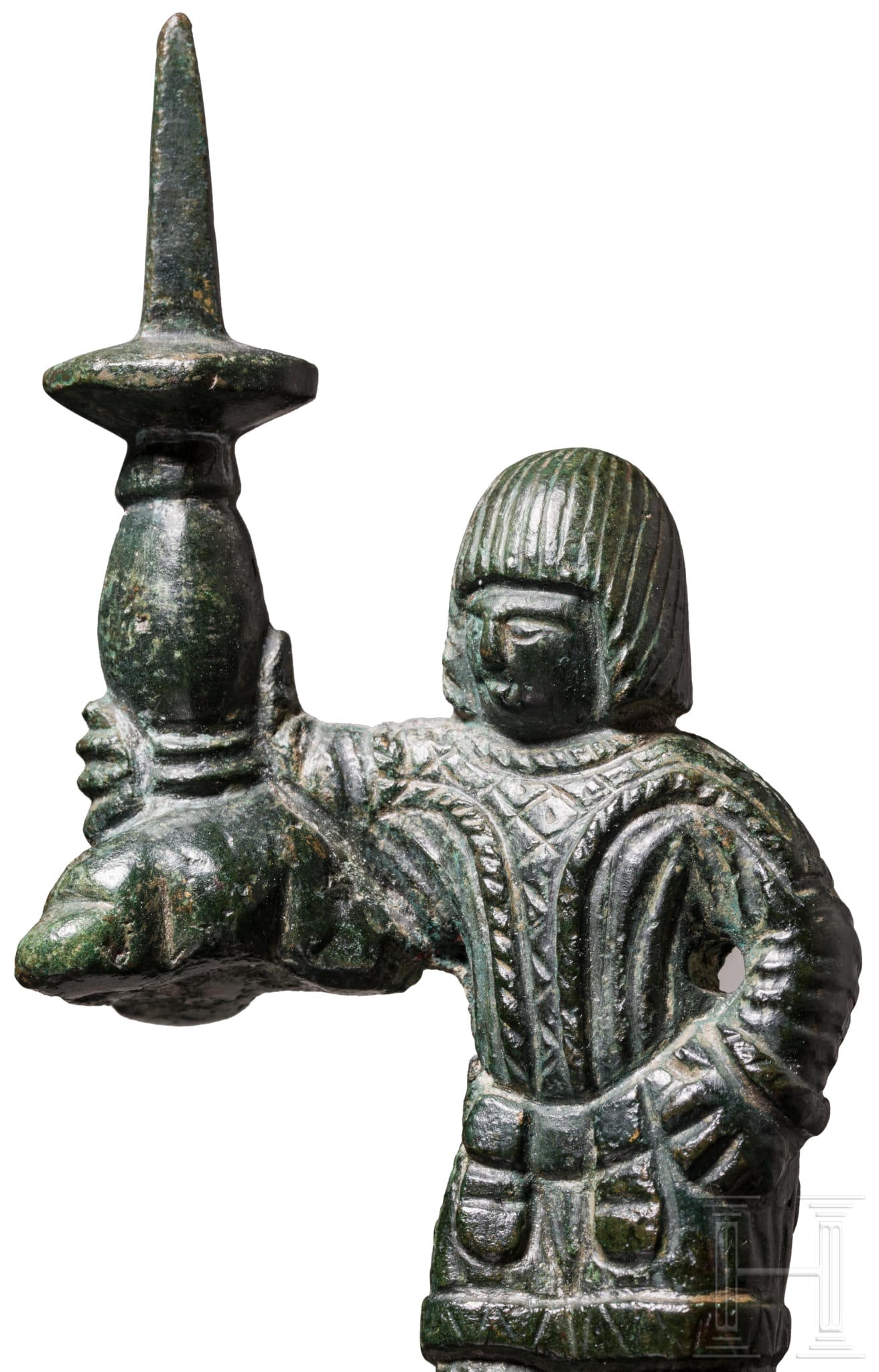
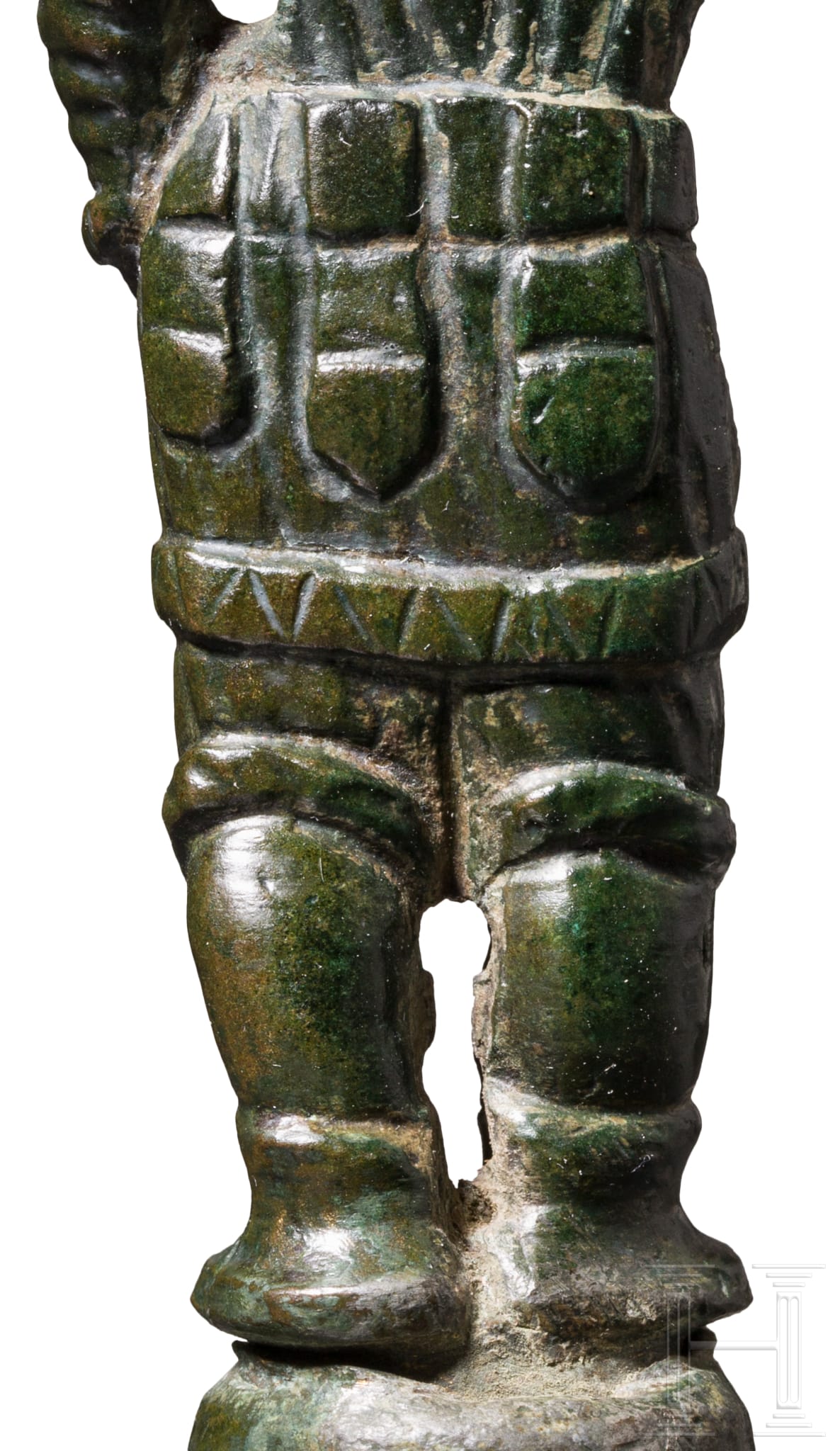
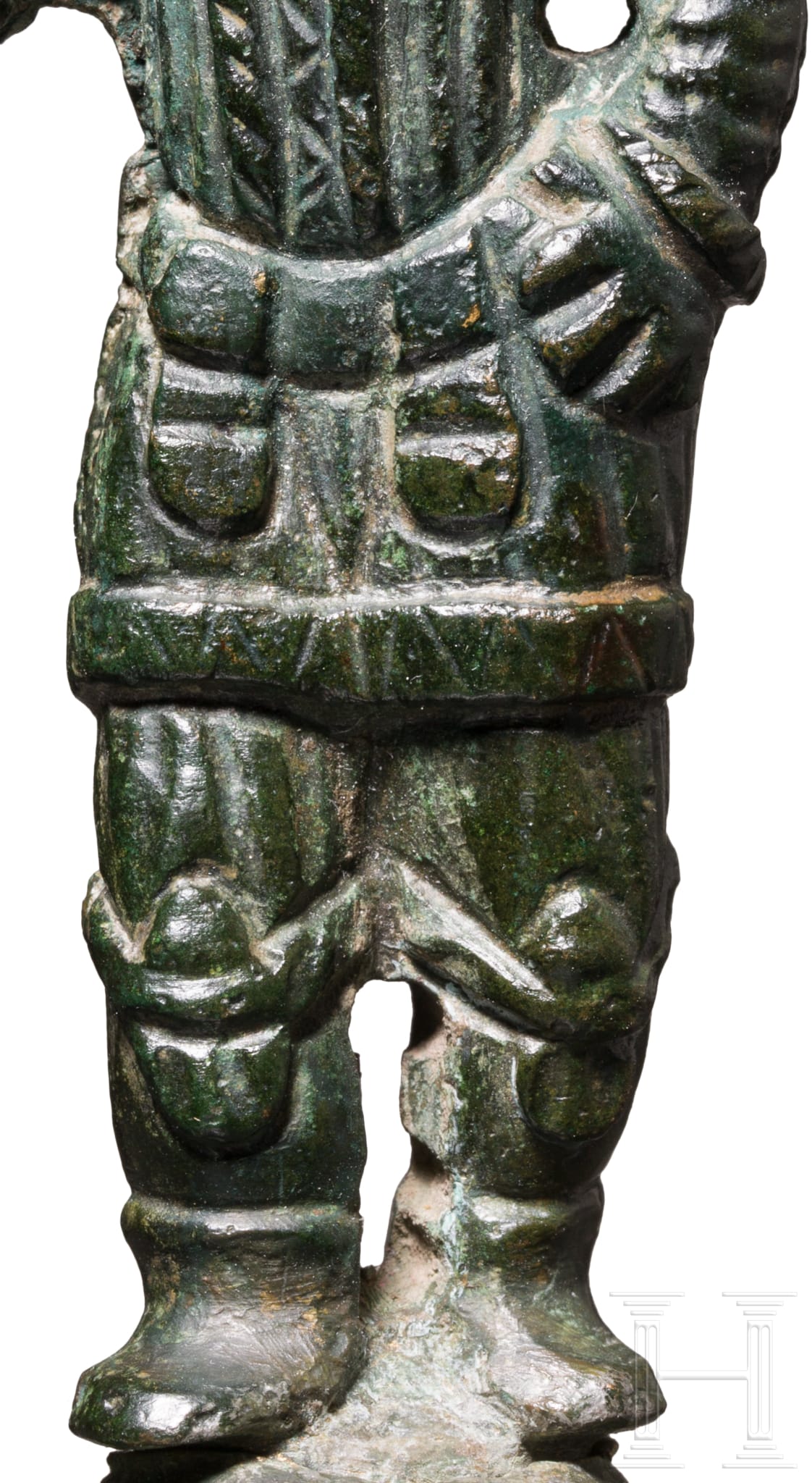
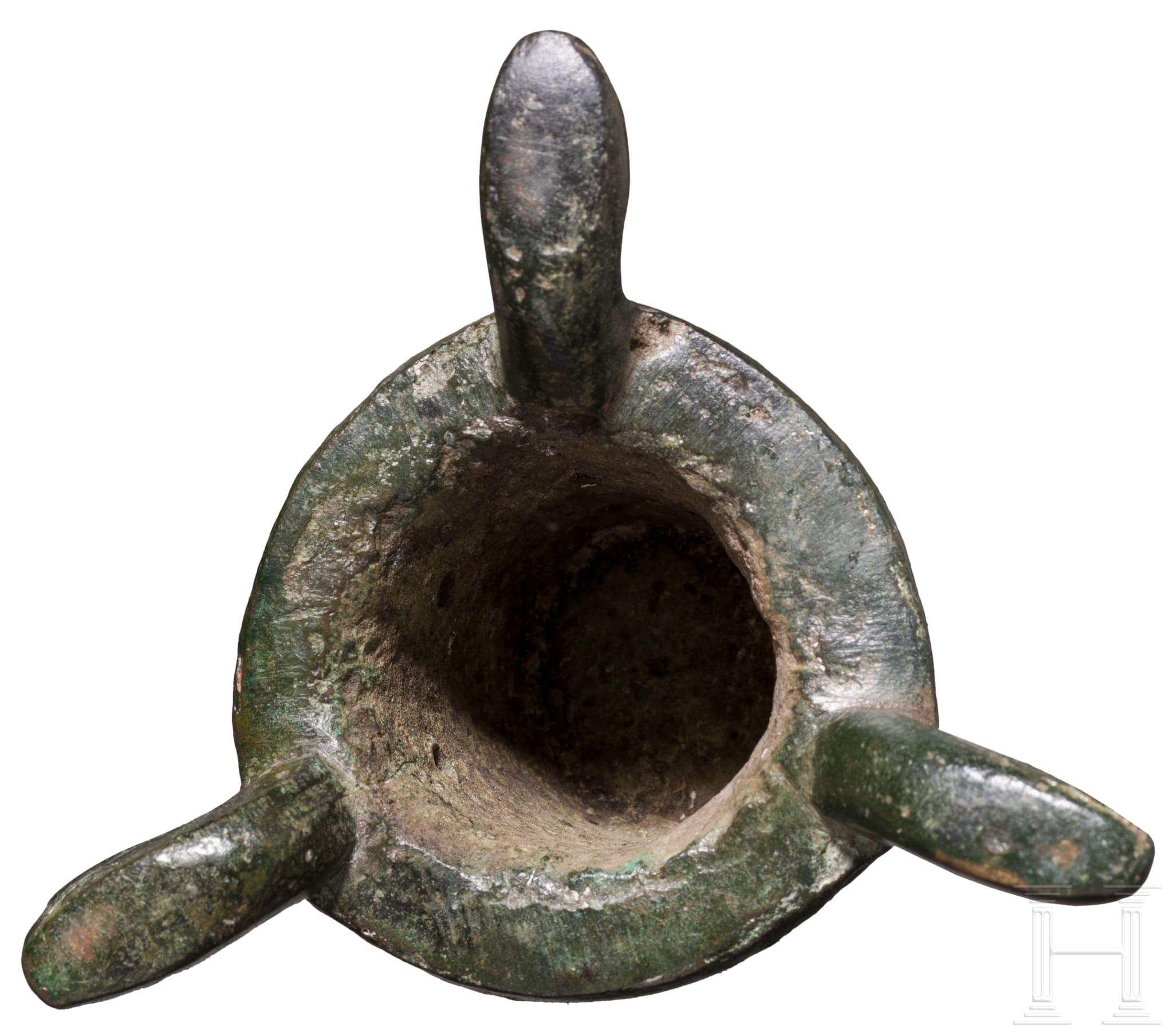
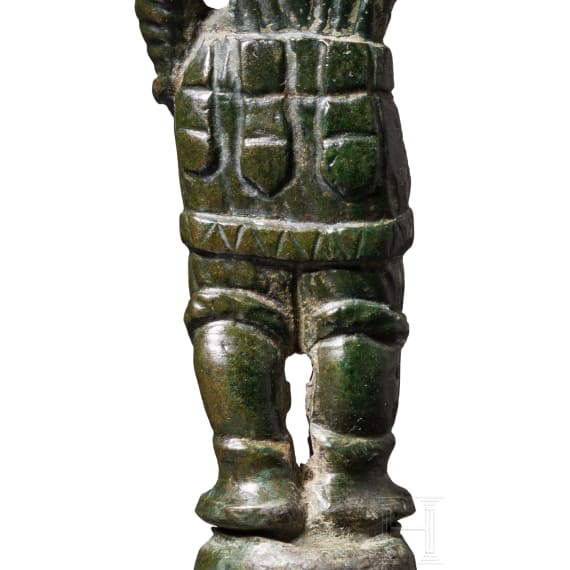
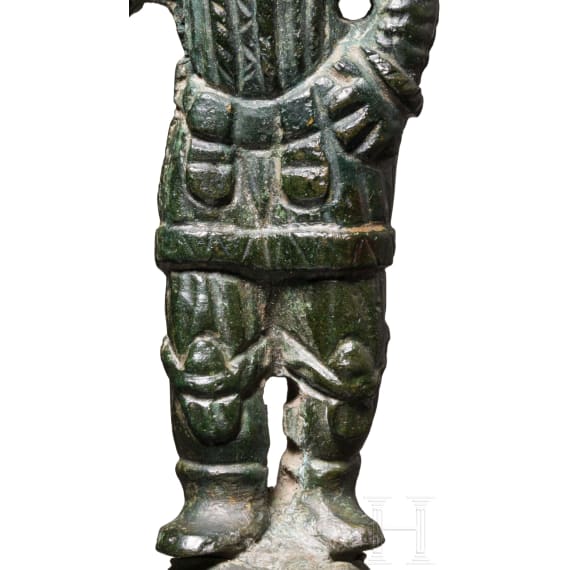
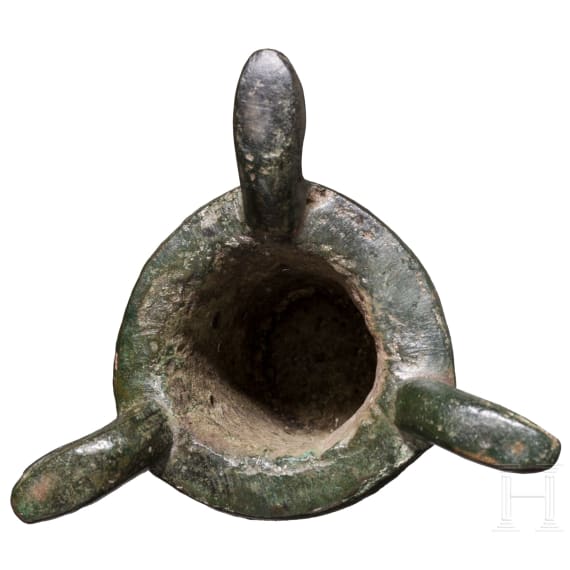
The plinth and figure were cast separately as two parts, which were carefully finished by hand whilst cold and finally joined by riveting. The riveted parts have minimal movement relative to one another. Three stylised dolphins, facing outwards and curving downwards, serve as "feet" and support a hollow, drum-shaped base that tapers slightly upwards, featuring floral decoration. The base is fitted at the bottom with a projecting, broad and slightly bevelled rim. Engraved at the top of this rim is a "lesbian kyma" consisting of a series of tongue-shaped leaf motifs, their curves facing outwards. Around the drum base are six palmettes with internal division formed by curved ribs. The palmettes are joined at the bottom by a semicircular arch, with a perforation above each one. The palmettes widen laterally in the upper section and curve inwards towards the tip, where the central rib of each palmette also ends. At the top, between the tips of the palmettes, are oval leaves with a central ridge, which protrude beyond the meeting, outward-curving sides of the palmettes. The base is topped by a robust, overhanging smooth slab. In the centre of this slab stands a low cone, upon which stands a soldier in a tunic and leggings tucked into mid-calf boots. His clothing and hairstyle resemble the depictions of "guardsmen" found in various works of early Byzantine art, including the mosaics in Ravenna. His hairstyle is a typical "pageboy cut" with a fringe and a deep bowl cut at the sides. The tunic is richly embellished with a wide, zigzag-patterned border along the lower edge; on the upper body, hatched vertical stripes over a background, the entire surface divided by lozenges with concentric circles in the centre. Slung around his hips, the soldier wears a belt from which vertical strips hang down – known as a multi-part belt. Engravings and slight variations in the relief depict the metal fittings of such a belt. Consequently, the date of manufacture cannot be earlier than the late 6th century and may extend into the 7th century. The relatively close-fitting trousers, with longitudinal pleats, are likewise decorated with stripes. The boots are plain. His left arm is at an angle, his hand resting on the belt. His right arm, extended horizontally, holds a simple, three-legged candelabrum with a conical base and a slightly domed, egg-shaped shaft, grooved at the top and bottom. The whole is topped by a disc-shaped plate with a square spigot. This handcrafted piece consists of two flambeaus nested one inside the other. A small oil lamp could be fitted onto the pricket of the small flambeau held in the soldier's hands, thanks to a precisely fitted recess in the lower part of the body. The surface is coated with a beautiful, glossy "noble patina" of a dark green hue, appearing almost as if the surface were enamelled. An exceptionally fine, virtually perfectly preserved example of a "soldier's flambeau", which, compared to known examples, can be regarded as by far the finest of its kind due to its state of preservation, completeness and artistic quality. Total height 17 cm, weight 441 g. A masterpiece of early Byzantine craftsmanship, featuring the stylisation typical of the period, whose individual decorative elements and details of the figurative representation clearly allow it to be dated to the late 6th century. There are many similar originals from the early Byzantine period to this simple flambeau held in the soldier's hand. Soldier's candlesticks may have been favoured for use by Byzantine military personnel. Owing to its significance, the piece has been extensively published and acclaimed by a renowned Byzantinist: Victor H. Elbern 1982, "Candle-holders for Byzantine soldiers". A brass candlestick in the shape of a soldier with a multi-part belt, Early Byzantine, late 6th to 7th century AD. In "Aachener Kunstblätter" 50, pp. 148–159. Reprinted in Victor H. Elbern. Fructus Operis III. Selected Art-Historical Writings from 1961–2007". Regensburg 2008, pp. 217–228. A metallurgical analysis carried out in 1979 at the State Museums of the Prussian Cultural Heritage Foundation in Berlin (Rathgen Research Laboratory) concluded that there is no evidence to suggest that the object does not date from the Byzantine period. CULTURAL ASSETProvenance: Acquired before 1979 by Cologne-based art dealer Axel Weber. In the Axel Guttmann collection since the early 1990s. In a private collection in Berlin since 2002.
Condition: I Questions about the lot?