


 91 / 946

Apart from these minor defects, an exceptionally well preserved speci-
men of this type of sword. Length 46 cm.
P
rovenance
:
From an Austrian private collection, acquired from an
Austrian collection during the 1990s.
245714
II -
€ 4.000
3125
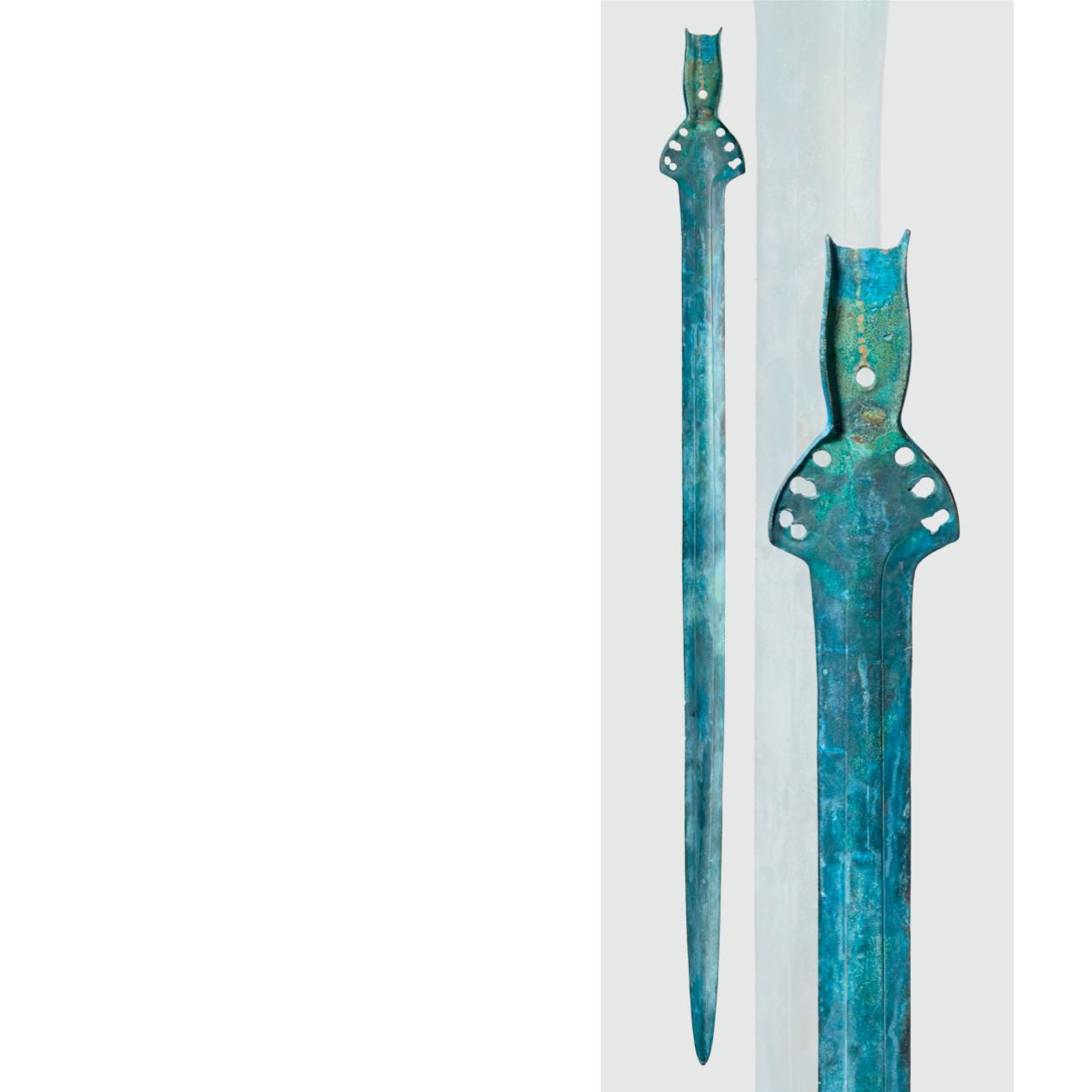
Griffzungenschwert, Späte Bronzezeit, 13. - 12. Jhdt. v. Chr.
Bronzenes Griffzungenschwert vom Typ Annenheim (Stufen Bronze-
zeit D bis Hallstatt A1). Charakteristische, lange schilfblattartige Klin-
ge mit von zwei gravierten Rillen begrenztem Mittelwulst, die sich im
vorderen Teil zur Spitze hin deutlich verjüngt. Die Rillen schwingen am
oberen Ende in die Griffplatte hinein nach außen aus, der Wulst setzt
sich bis zum Beginn der Griffzunge mit leicht nach außen gebauchten
Rändern fort, die in der Mitte massiv, aber flach ist und ein einziges
Nietloch besitzt. Die ebenso charakteristische, annähernd halbkreis-
förmige Griffplatte setzt sich unten deutlich von der Klinge ab, zu der
hin sie in einem stumpfen, aber doch noch markantem Winkel ein-
schwingt. An den Seiten je drei Löcher für Niete, die beiden unteren
auf beiden Seiten doppelt gesetzt. Griffzunge und Griffplatte durch
Randleisten eingefasst, die oben hörnchenartig leicht nach außen aus-
zipfeln. Seitlich minimale, kaum sichtbare Welle in der Klinge. Abge-
sehen von zwei minimalen, bereits antiken Scharten an der Schärfe na-
hezu perfekt erhaltenes Prachtexemplar eines Griffzungenschwertes
mit herrlicher, grün-blauer Patina auf der gesamten Oberfläche. Wie
bei diesem Schwerttyp üblich von ausgezeichneter, handwerklicher
Qualität. Mit 70 cm Länge am oberen Ende der bekannten Schwan-
kungsbreite.
Provenienz: Österreichische Privatsammlung, erworben in den 1990er
Jahren aus anderer österreichischer Privatsammlung.
A leaf blade sword, late Bronze Age, 13th – 12th century B.C.
Bronze leaf blade sword of Annenheim type, dating from the late
Bronze Age (Bronze Age phases D to Hallstatt A1). Characteristically
long, reed-shaped blade with a pronounced medial rib accentuated by
two engraved fullers, tapering sharply towards the point in the front
section. The fullers flaring outwards towards the grip plate at the top,
the medial rib continuing with slightly bulbous flanges to the root of
the tang, which is solid yet flat in the centre and has a single rivet hole.
The equally characteristic, almost semi-circular grip plate is clearly
distinguished from the blade at the bottom, curving back in towards
it in an obtuse, yet striking angle. Three perforations for rivets on the
sides, the two lower holes perforated twice on both sides. The tang and
grip plate edged with border strips, these extending slightly into curved
finial horns at the top. A minimal, barely visible wave in the blade at
the side. Apart from two minimal, ancient notches in the cutting edge,
a magnificent leaf blade sword in almost immaculate condition, with
a superb, greenish-blue patina all over the surface. Forged with excep-
tional workmanship, as is customary for this type of sword. Measu-
ring 70 cm in length, it is at the upper end of the established range of
variation.
P
rovenance
:
Private Austrian collection, acquired from another pri-
vate Austrian collection during the 1990s.
245712
II -
€ 3.000
|
89
3125