Lot 864
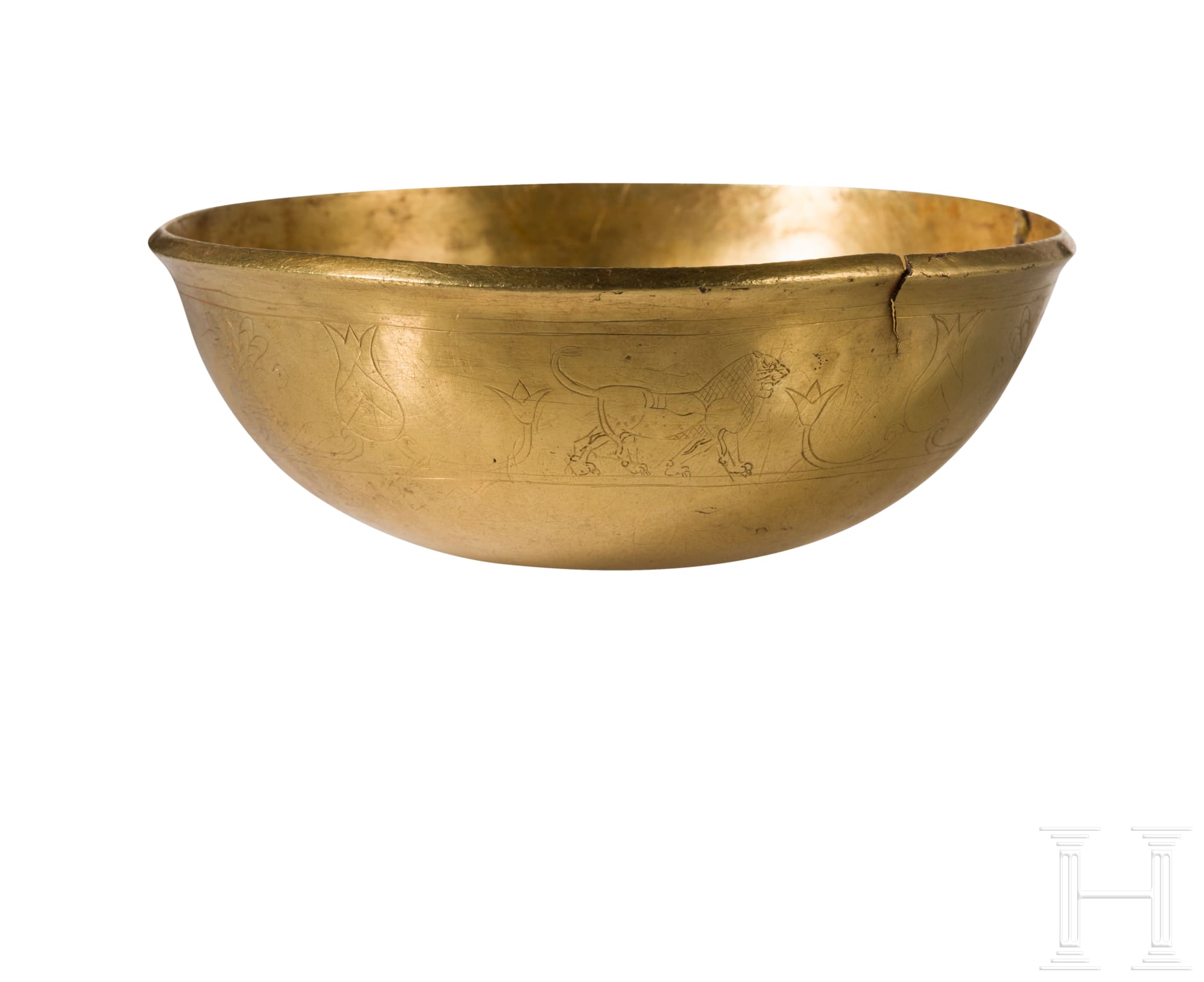
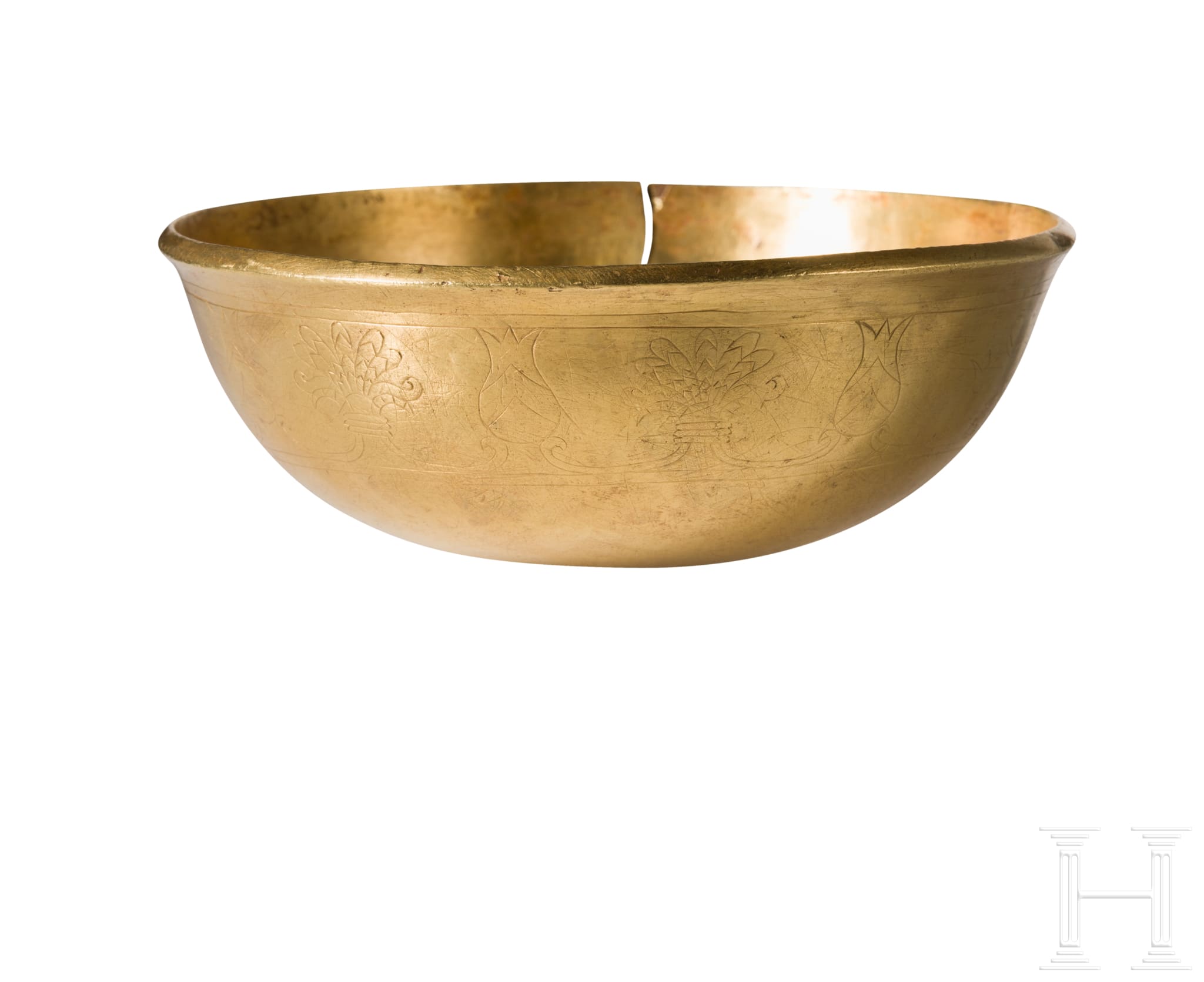
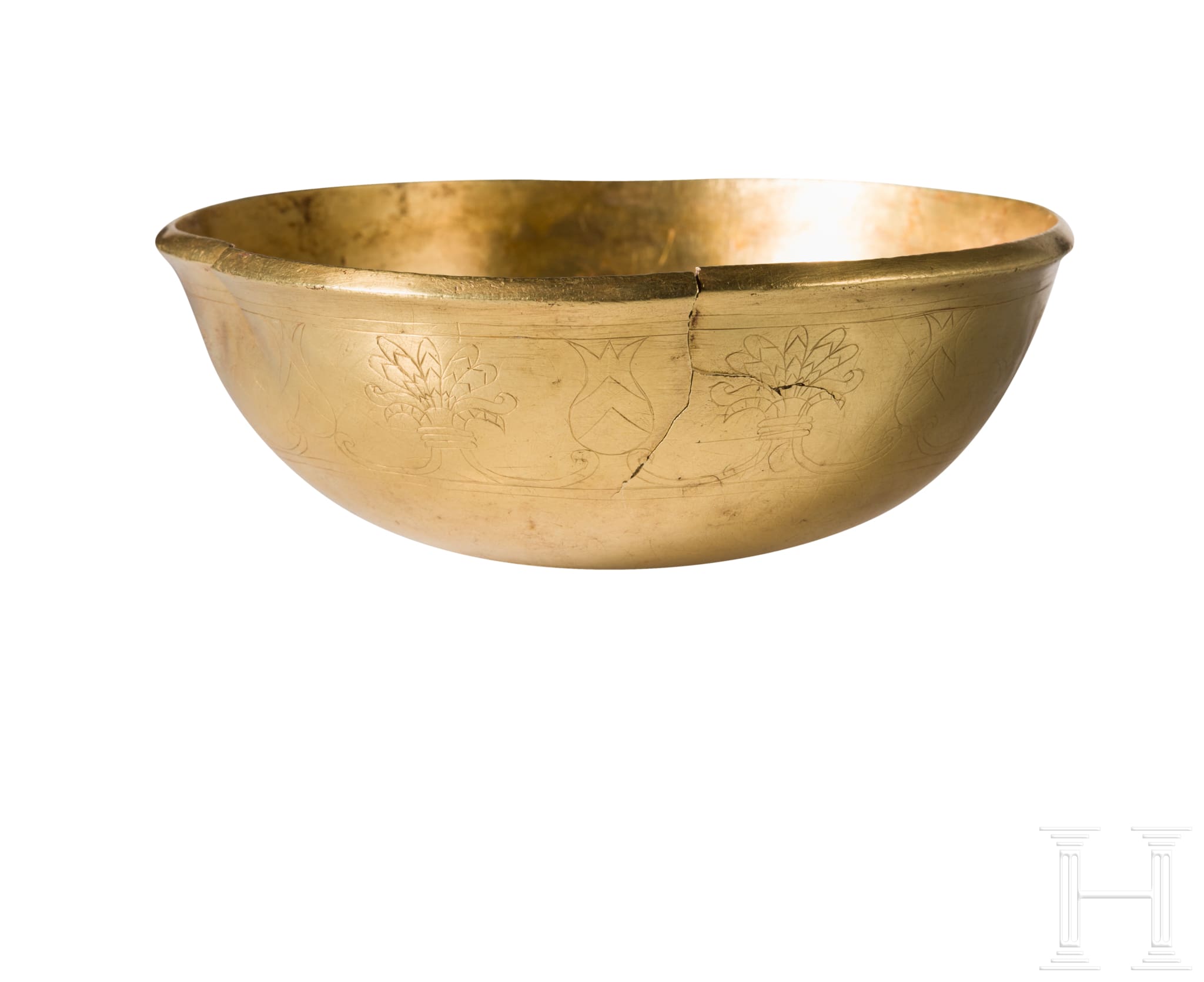
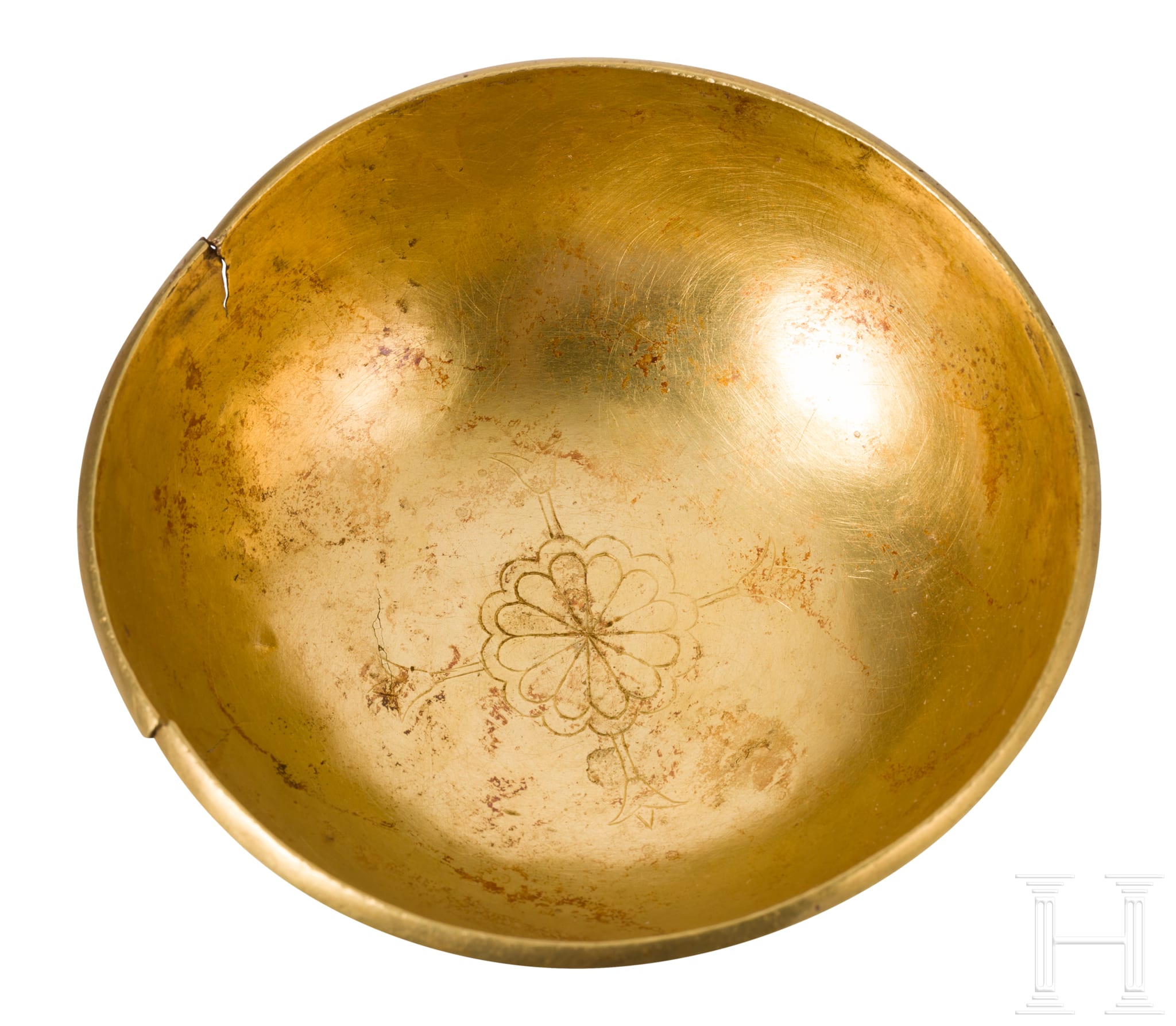
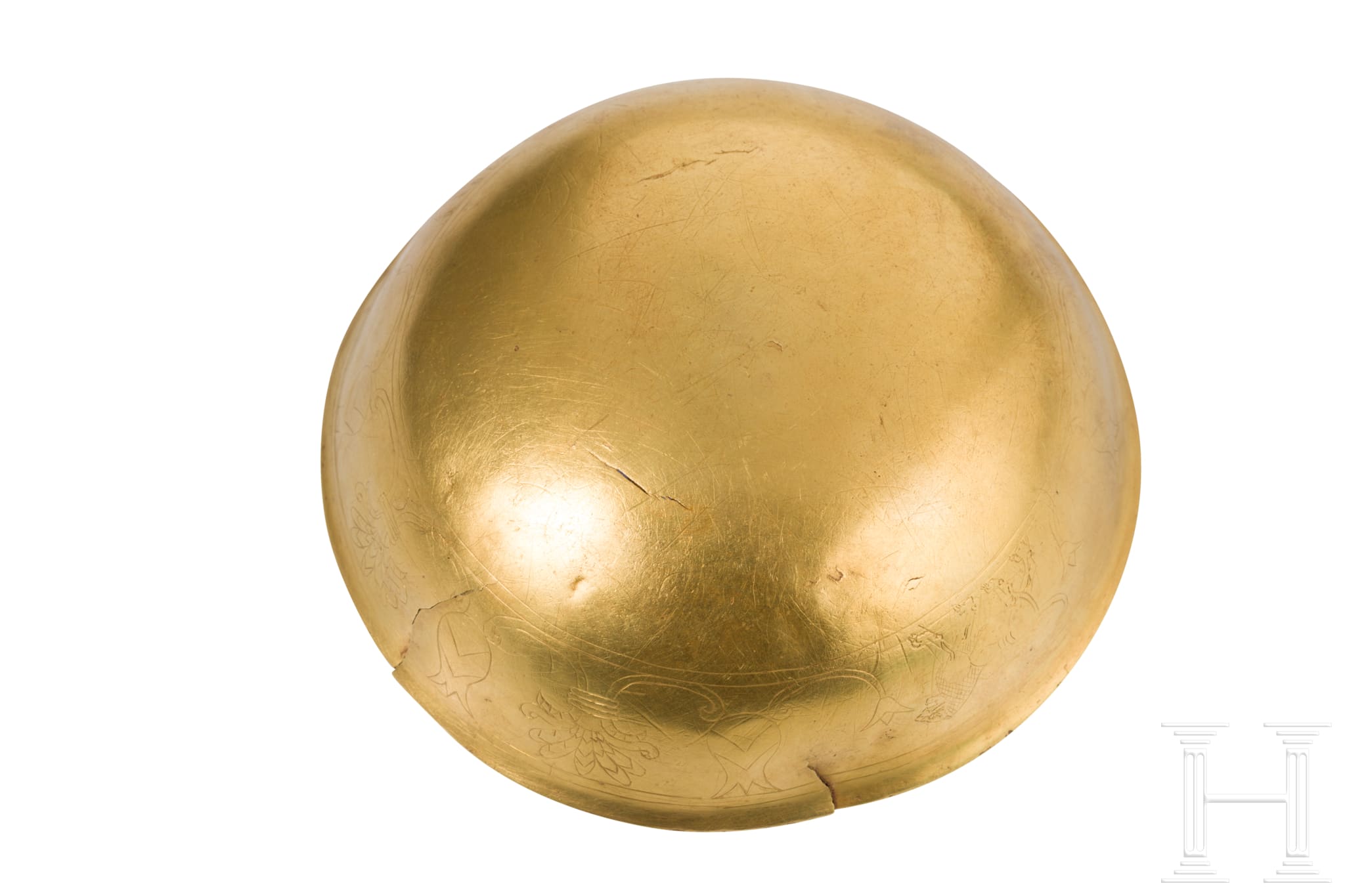
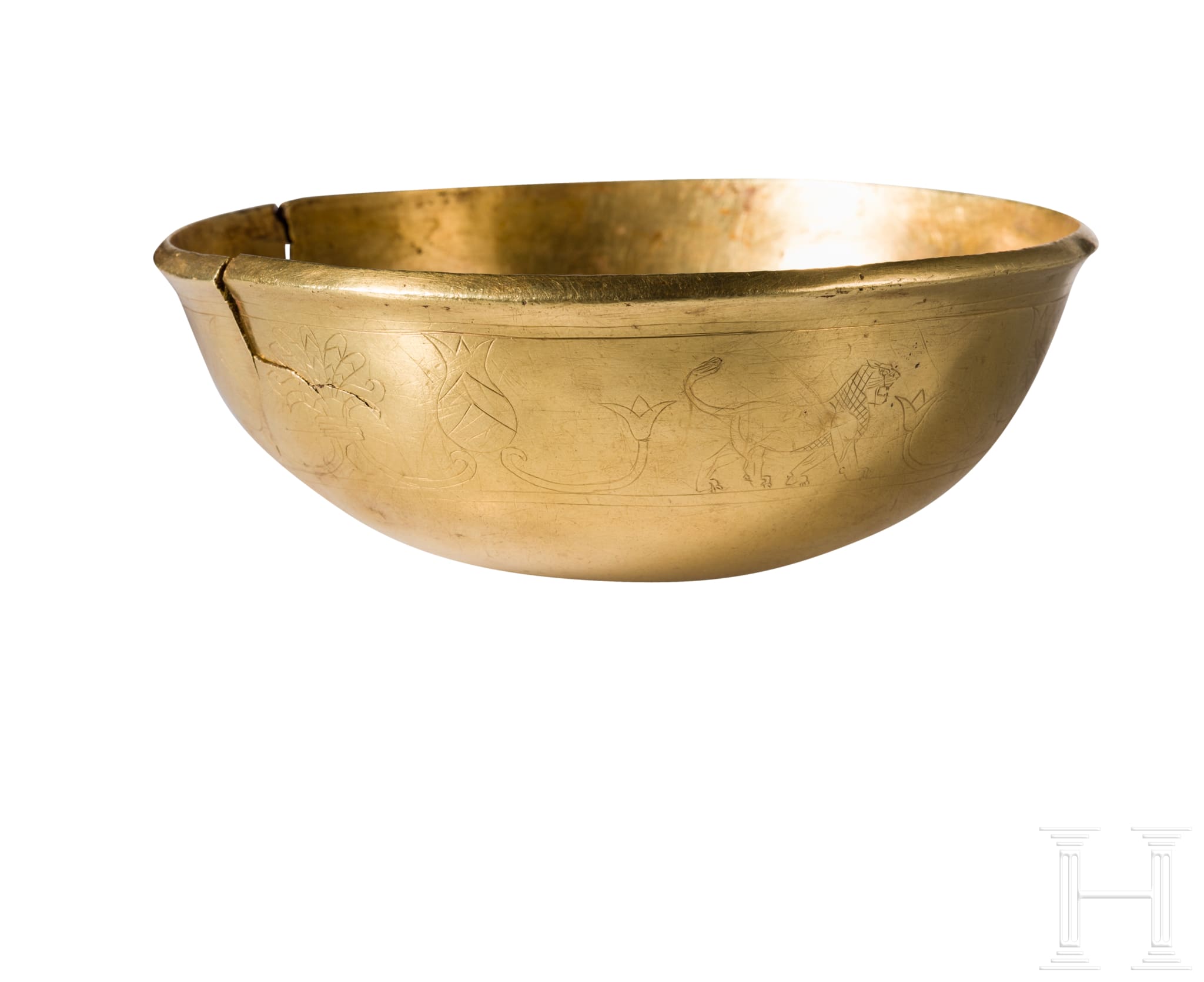
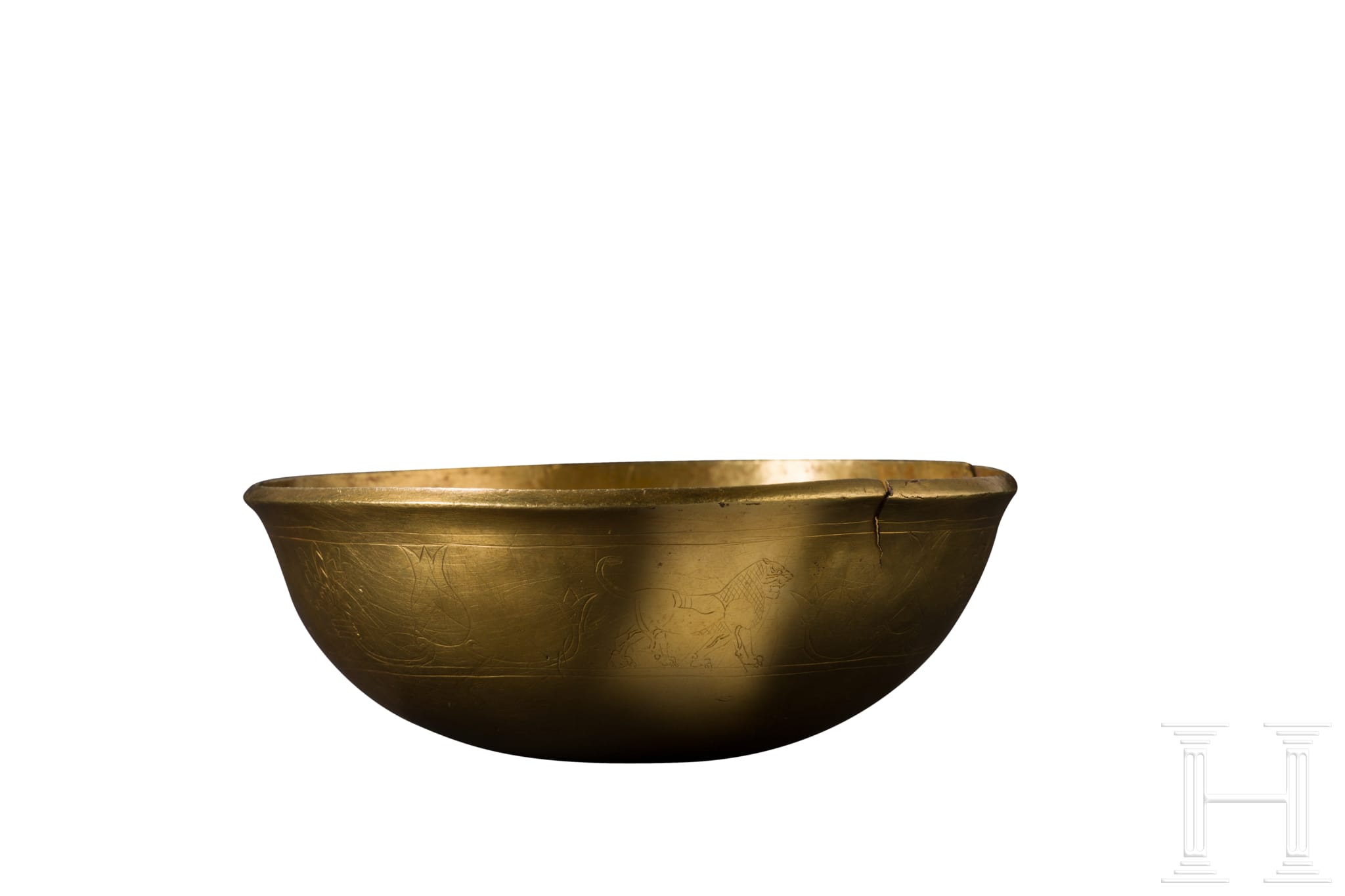
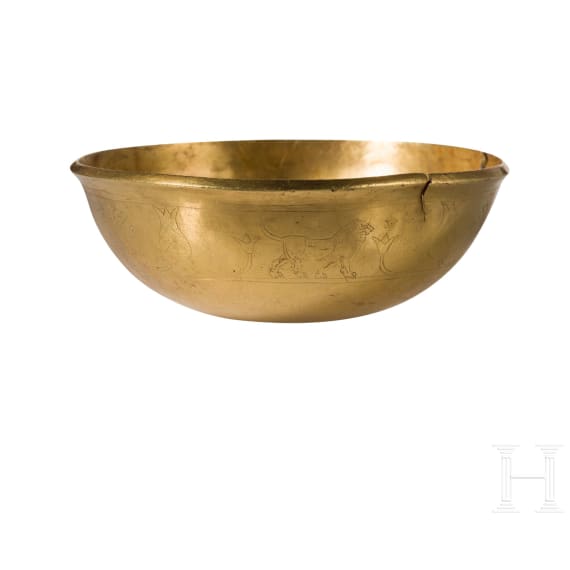
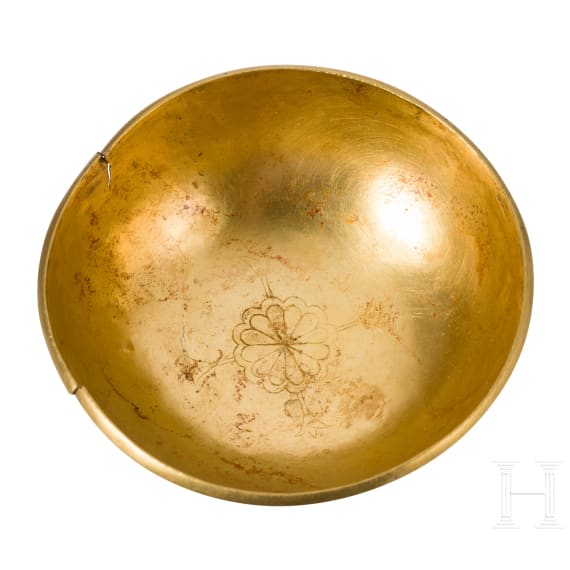
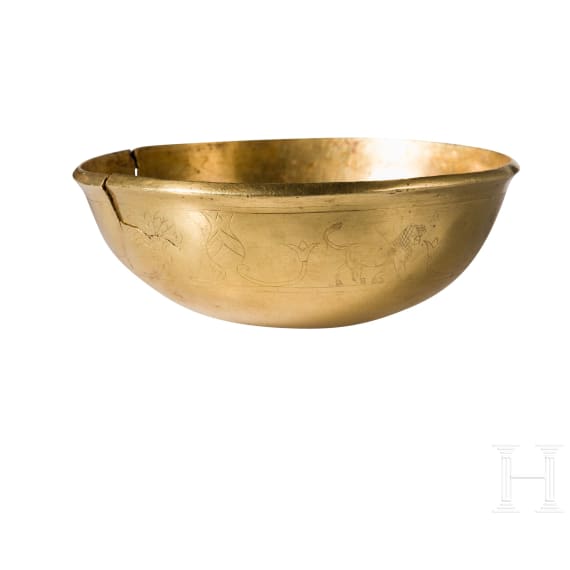
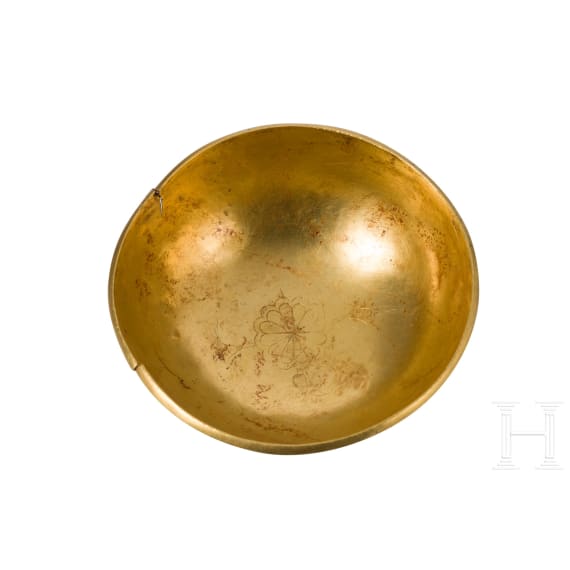
An ornate gold bowl featuring elements of Neo-Babylonian and Neo-Assyrian art; ritual vessel from a royal court, first half of the 6th century B.C.
Works of Art, Antiquities & Ancient Art | A109kua | Live auction | 1190 Lots
Description
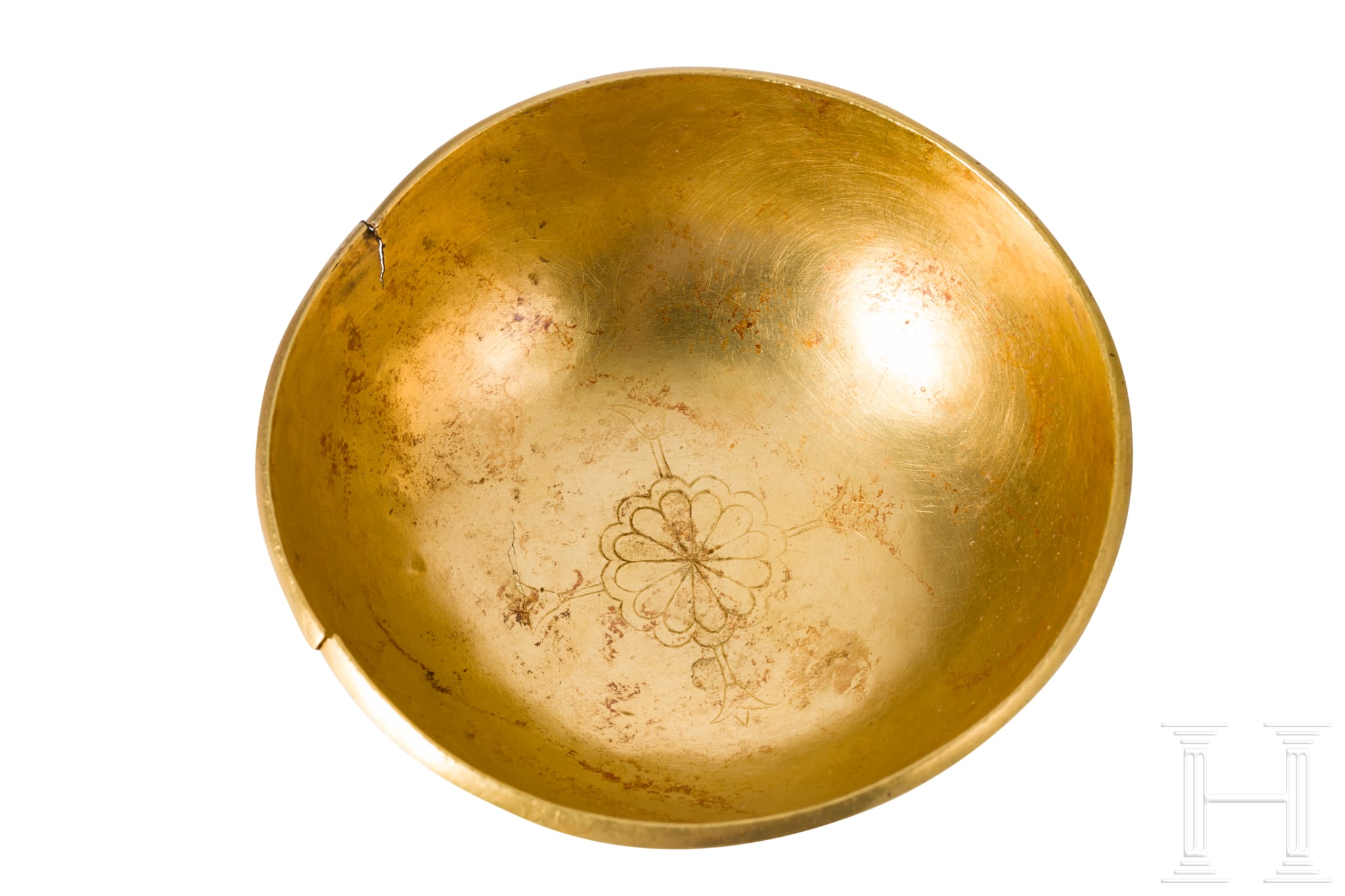
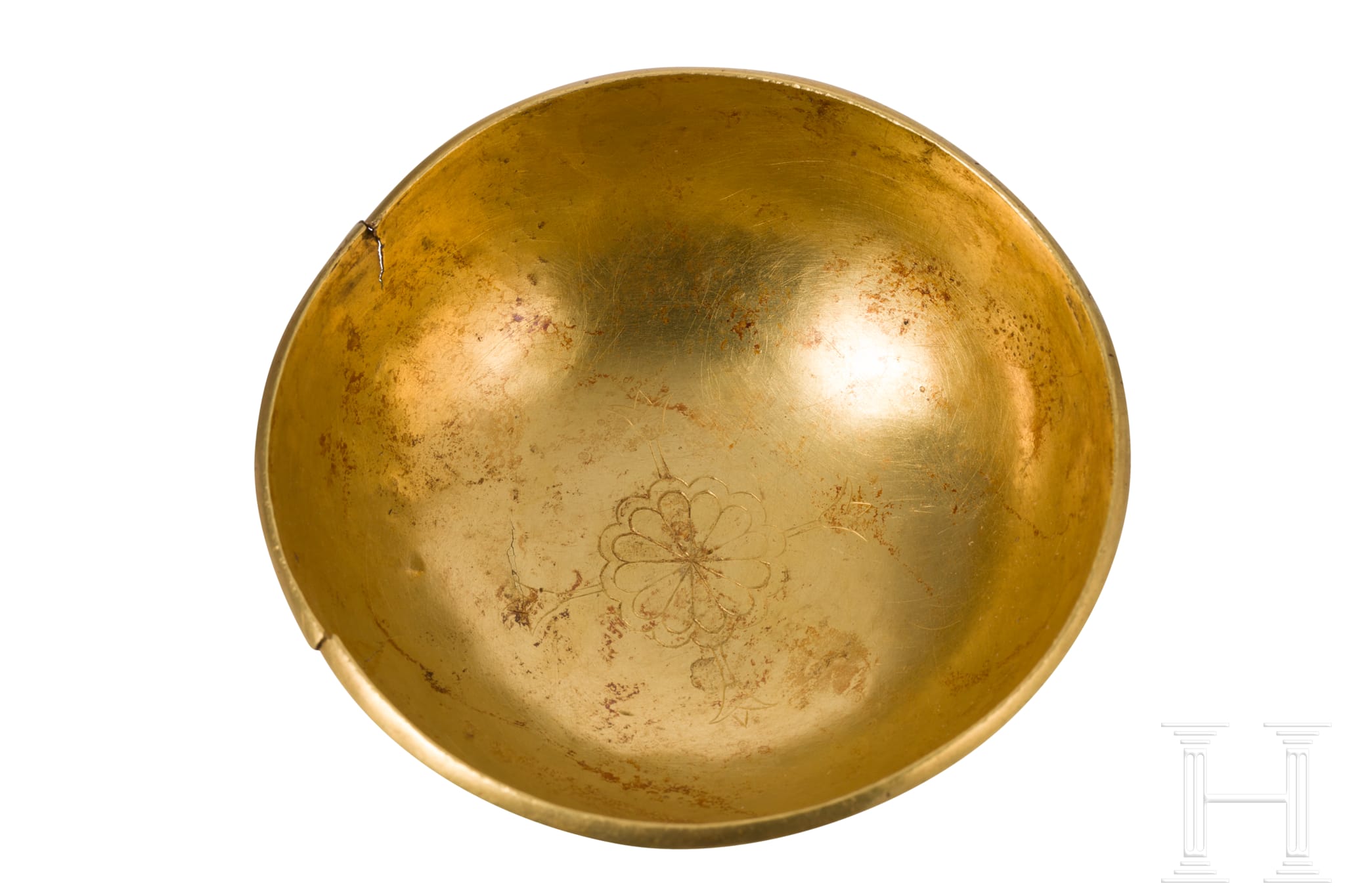
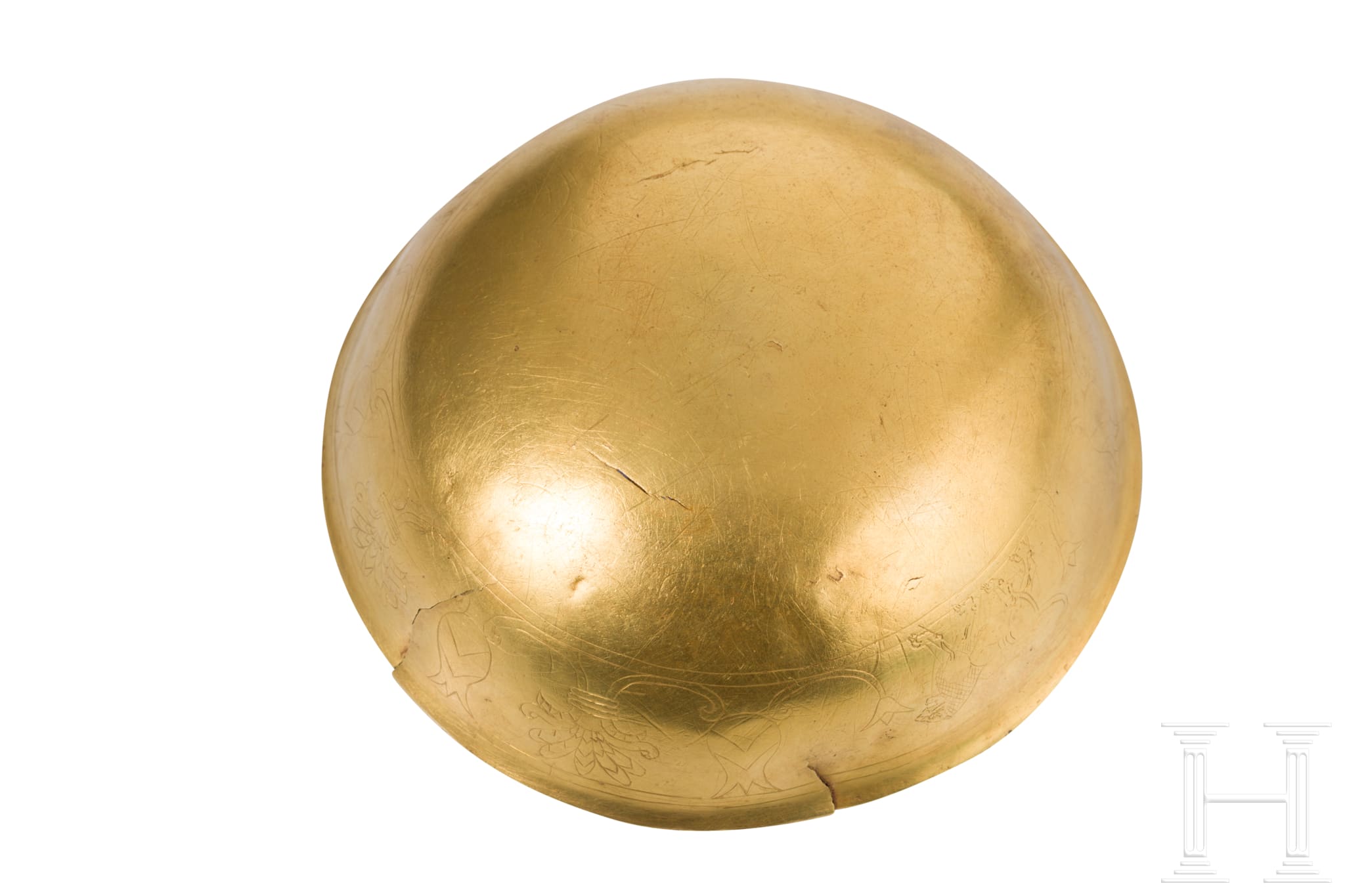
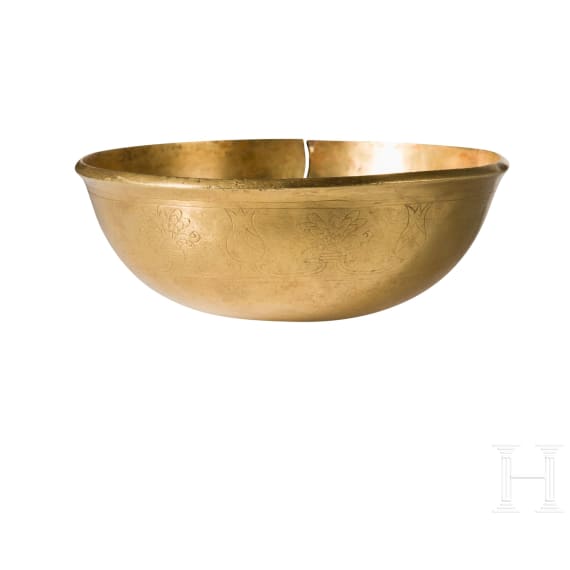
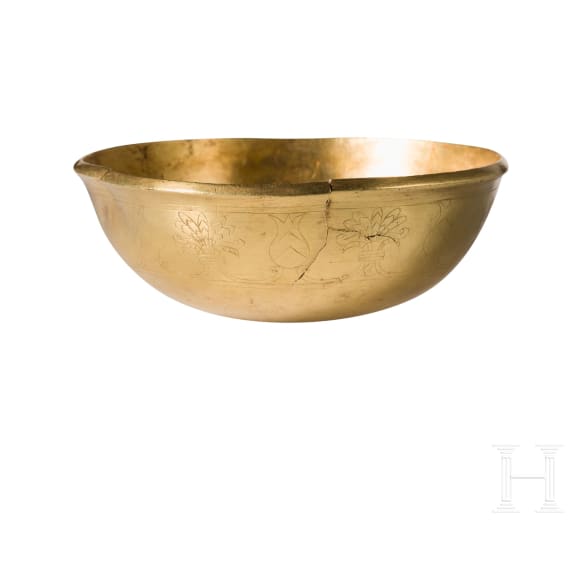
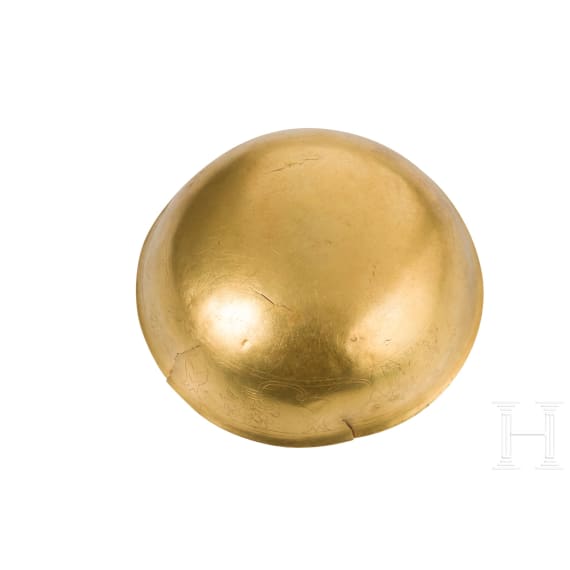
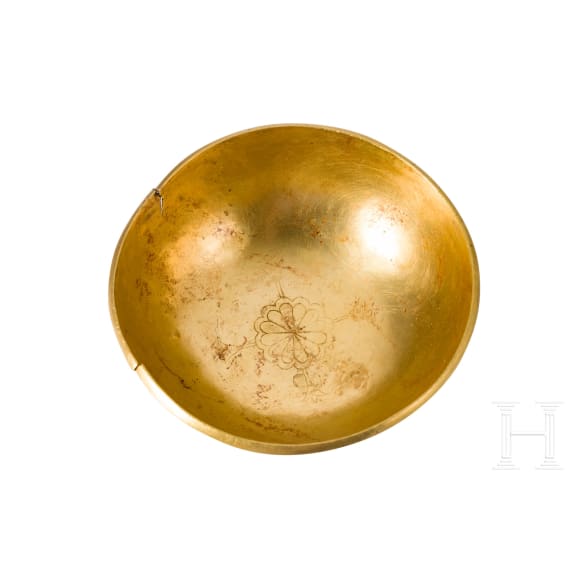
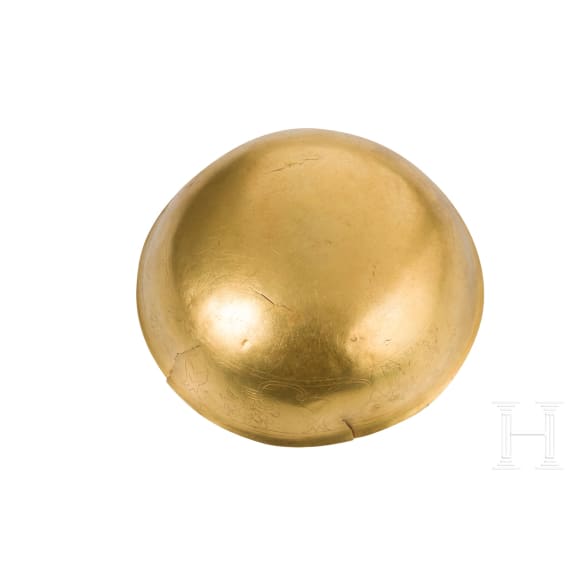
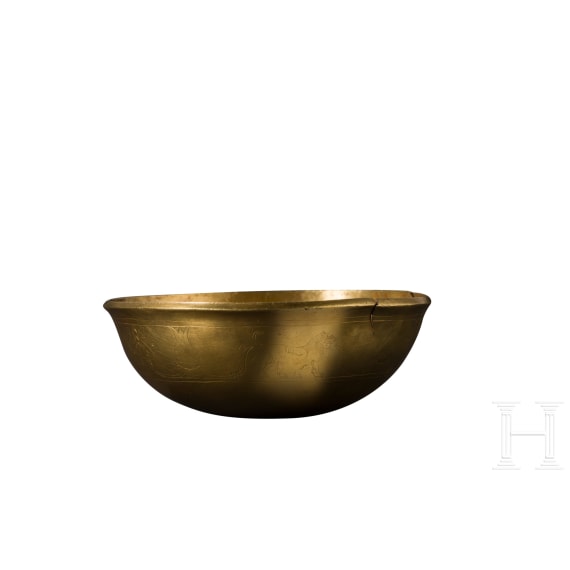
A thick-walled bowl with a circular diameter of 12.6 cm; its dome-shaped, fully rounded wall, which lacks a base, is slightly less curved in the lower, central section than in the steeper, outer sections below the rim. Height 5 cm. The rim is distinctly thickened on the outside and features a sharp break; it is flat in the upper part, but tapers slightly towards the wall below. On the outer wall, just below the rim, there is a decorative field bounded at the top and bottom by two parallel incised lines running all the way round, featuring floral and animal motifs executed in punch-mark and engraving techniques; a repeat pattern consisting of two identical sequences. One sequence consists of three closed flowers, with a five-petalled palmette placed in the space between each pair; from the bottom of each palmette emerge two stems curled inwards at the ends, the coils of which touch the closed flowers at the lower rim. A similar stem is situated at the beginning and end of the floral elements in the sequence. However, it does not extend out into a palmette but into a significantly smaller, half-open flower. Following the right-hand, half-open flower, a right-facing lion passant with its tail curled upwards is punched and engraved. The mane is depicted using cross-hatching in the opposite direction; the ears are close to the head and the maw is wide open. Further anatomical details, such as the eyes or prominent muscle groups, are rendered using punching. Inside the bowl, at the centre, is a twelve-petalled rosette, also punched and engraved, the petals radiating from the centre of the bowl. The rounded tips of the petals are further framed on the outside by parallel arcs. Beneath the rosette motif, four short stems arranged in a cross-shaped pattern protrude, bearing half-open flowers at their tips, as on the outer pattern repeat. The thickness of the material varies between 0.6 and 4.5 mm, although this is not visually noticeable. There are two vertical cracks (3.2 cm and 1.5 cm) at the edge of the shell, 6.5 cm apart. A transverse crack extends from the larger of the two. Furthermore, there are various small "imperfections" on the surface, some of which are due to the manufacturing process and others to signs of wear and minor damage: tiny spalls, cracks, fissures and scratches, particularly on the outside in the area of the decorative band. The antique signs of wear can be clearly distinguished from the modern scratches. In addition, there is a reddish patina on the vessel in patches and spots; this is a natural deposit or diffusion of iron from the soil into the gold surface – a further indication of the object's authenticity. The manufacturing technique and material composition are unusual. Archaeometric analyses have suggested that the object was produced from a gold amalgam in a negative mould, particularly in view of the high mercury content in the alloy (over 10 per cent), as well as 1 per cent silver and a gold content of almost 87 per cent; this is analogous to the use of negative moulds for high-quality glass products from the same period. Gold amalgams have already been confirmed in objects from Eurasia; however, due to a lack of analyses of ancient Near Eastern gold objects, their prevalence has so far only been partially documented. From a cultural-historical perspective, the bowl is a late example of ancient Near Eastern metal bowls of type 1E, according to the classification by P.H.G.H. Smith (1986), a type that has been in use since the mid-2nd millennium B.C. However, an art-historical analysis of the ornamental elements in the context of contemporary works of art clearly points to a dating in the first half of the 6th century B.C., including ivory carvings from the period or the wall panelling of the Processional Way and the throne room façade of the Royal Palace in the South Fortress of Babylon (both 6th century B.C.). The weight of 251.2 g corresponds quite precisely to half a "mine" (250 g). Indeed, contemporary cuneiform texts mention this weight on several occasions in relation to gold vessels. Owing to its late dating, the bowl is the only known example to date from this late period, from which very few gold artefacts are known anyway, and which chronologically corresponds roughly to the final heyday of the Neo-Babylonian Empire. The unknown context of its discovery and its hybrid character – featuring ornamentation drawn from Neo-Assyrian, Neo-Babylonian and North Syrian traditions – mean that its precise regional and historical attribution remains a matter of speculation. In any case, the bowl belongs in the context of a royal court, where lion hunting was a royal privilege and was frequently depicted as a means of royal self-representation, including on works of art both large and small. In connection with the lion hunt, records also exist of libations of ritual beverages poured from such bowls, for example on a stone relief from the North Palace of Ashurbanipal (668–630?) in Nineveh, which also provides a clear depiction of the hand posture during the performance of such rituals. The use of such bowls is also attested in other ceremonial contexts of ancient Near Eastern court culture. The bowl thus represents a unique cultural artefact of museum-quality significance from the final heyday of the ancient Near Eastern kingdoms and principalities prior to the dominance of the Persian Achaemenid Empire from the late 6th century onwards. As part of a collaboration between classical studies institutions in Würzburg and Berlin, a dedicated exhibition was held in the summer of 2006 at the Martin von Wagner Museum of the University of Würzburg in the Würzburg Residenz (title: "Art and Technology in the Ancient Near East. A Babylonian Gold Bowl under Scrutiny"). At the same time, an academic monograph was published containing numerous contributions from various disciplines, which subjected all aspects of the gold bowl to a detailed examination: Herrmann Born und Elisabeth Völling: Gold im alten Orient. Technik - Naturwissenschaft - Altorientalistik. Würzburg, 2006 CULTURAL ASSETProvenance: Acquired by the current owner in 2002 from a private British collection. Brought to London by the previous owner in 1980 and registered with a notary in the same year; its ownership has been verified by the Art Loss Register in London and Cologne. Acquired by the previous owner's father in 1961.
Condition: I - Questions about the lot?