


 116 / 946

114
|
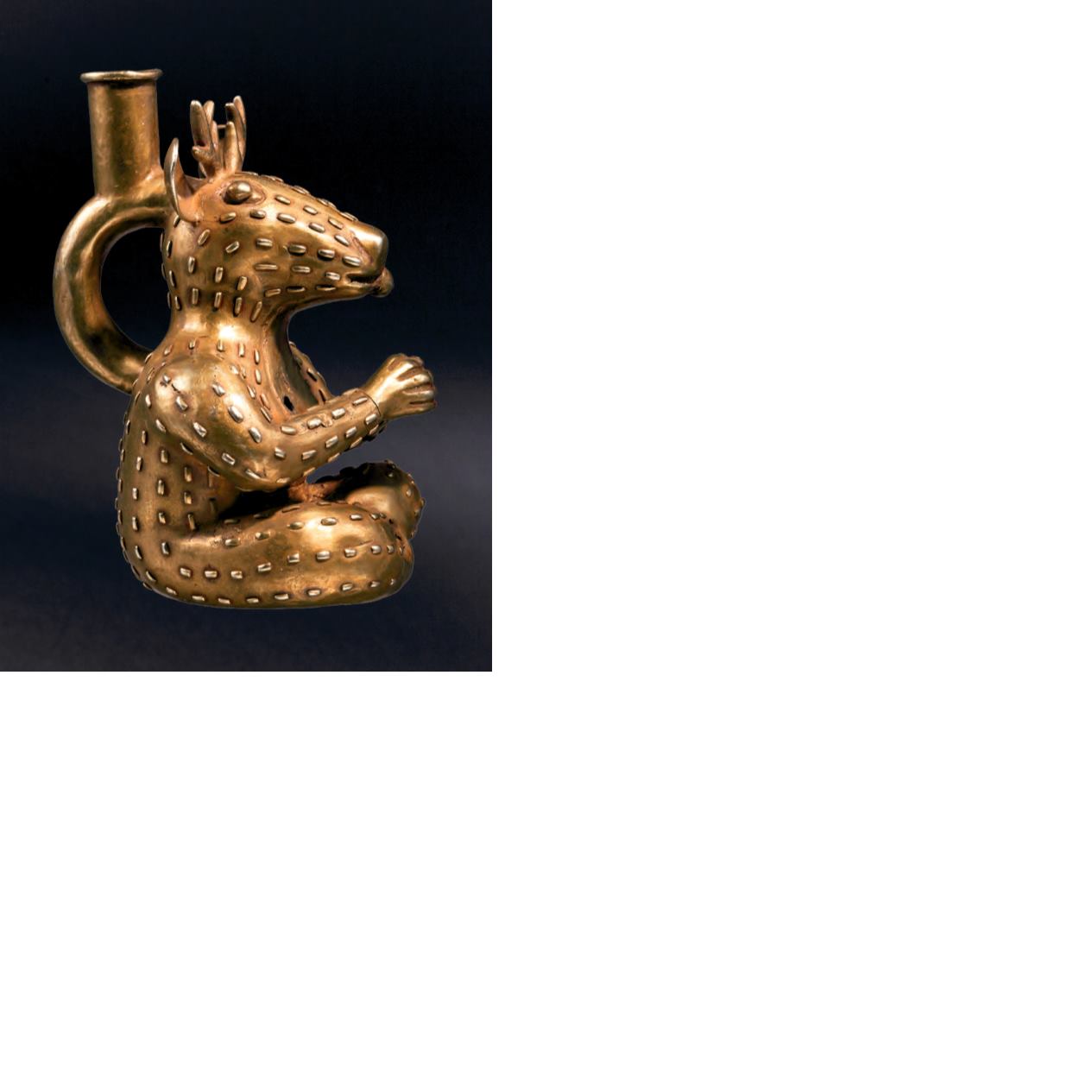
Tierfigur. Vielmehr dürfte es sich um ein Mischwesen mit mensch-
lichen Zügen handeln. Die Gliedmaßen der Länge nach mit Reihen
von plastisch erhabenen, länglichen Knubben versehen, die wohl eine
Fellstruktur andeuten sollen. Der längliche Kopf mit leicht geöffnetem
Mund, aus dem seitlich die Zunge heraushängt, darüber eine deutlich
ausgearbeitete Nase, ferner mandelförmige Augen mit expressiv her-
vortretenden Pupillen, dahinter Geweih und Ohren. Am Hinterkopf
ein hohler, im Bogen auf den oberen Teil des Rückens geführter Hen-
kel, auf dessen Oberseite ein senkrechte, zylindrische Röhre sitzt, die
durch eineWulst abgeschlossen ist. Diese war wohl ursprünglich durch
einen Deckel mit Nadel zum Aufnehmen des Inhalts (wohl Kalk, der
beim Genuss von Koka-Blättern mit gekaut wird) verschlossen. Die
hohle Figur auf der Brust und einemHinterbein durch ein kleines Loch
antik beschädigt. Auf den Hinterbeinen zwei ebenfalls antike Schnitt-
spuren. Ansonsten intakt. Außergewöhnlich schöne und reizvolle prä-
kolumbische Figur eines Fabelwesens. Höhe 10,2 cm. Gewicht 120 g.
Bestandteile der Goldlegierung (Tumbaga) aufgrund einer Röntgen-
fluoreszenzanalyse: Gold ca. 42,7%. Silber ca. 37,2%. Kupfer ca. 20%.
Provenienz: Aus der Sammlung eines süddeutschen Künstlers, erwor-
ben in den 1960er Jahren im Kunsthandel.
A Pre-Columbian gold vessel in the shape of a cervid, Quimbaya
civilization, 9th - 15th century B.C.
The vial in the shape of a squatting cervid (half man, half stag?) with
crossed hind legs, the fore limbs with bent arms folded together across
the chest, the hands with five stylised fingers clasped together at the
breast. The stylisation of the fingers resembles that of human hands
in other sculptures made by this culture, thereby refuting the depiction
of a purely animal figure. On the contrary, this is likely to be a hyb-
rid creature with human features. The limbs featuring rows of three-
dimensional, elongated lugs, set lengthwise, presumably to suggest the
structure of fur. Elongated head, the mouth slightly opened, the tongue
hanging out at the side, above which a prominently sculpted nose, plus
almond-shaped eyes with expressively protruding pupils, behind which
the antlers and ears. At the back of the head is a hollow handle, attached
to the upper part of the back by an arc, bearing a vertical, cylindrical
tube on the top, which terminates in a ridge. This probably originally
had a lid, fitted with a pin to extract the contents (presumably an alkali-
ne substance, which is also chewed with the coca leaves). The breast and
one hind leg of the hollow figure damaged with a small, antique hole.
Furthermore, two cut marks on the hind legs, also antique. Otherwise
intact. An exceptionally splendid, delightful pre-Columbian figure of a
mythological creature. Height 10.2 cm. Weight 120 g. The various com-
ponents of the gold alloy (tumbaga), based on an X-ray fluorescence
analysis: gold circa 42.7 %. Silver circa 37.2 %. Copper circa 20 %.
P
rovenance
:
From the collection of a South German artist, acquired
in the art trade during the 1960s.
239370
II -
€ 10.000
ALTAMERIKANISCHE KULTUREN
3158
Goldgefäß in Form eines Cerviden, Quimbaya Kultur,
Kolumbien, 9. - 15. Jhdt.
Fläschchen in Gestalt eines hockenden Cerviden (Hirschmenschen?)
mit verschränkten Hinterbeinen, die vorderen Gliedmaßen mit ange-
winkelten Armen vor der Brust zusammengeführt, wo Hände mit fünf
stilisierten Fingern vor der Brust zusammengeführt sind. Die Stilisie-
rung der Finger gleicht derjenigen von Menschenhänden an anderen
Plastiken dieser Kultur und spricht gegen die Darstellung einer reinen