


 62 / 946

60
|
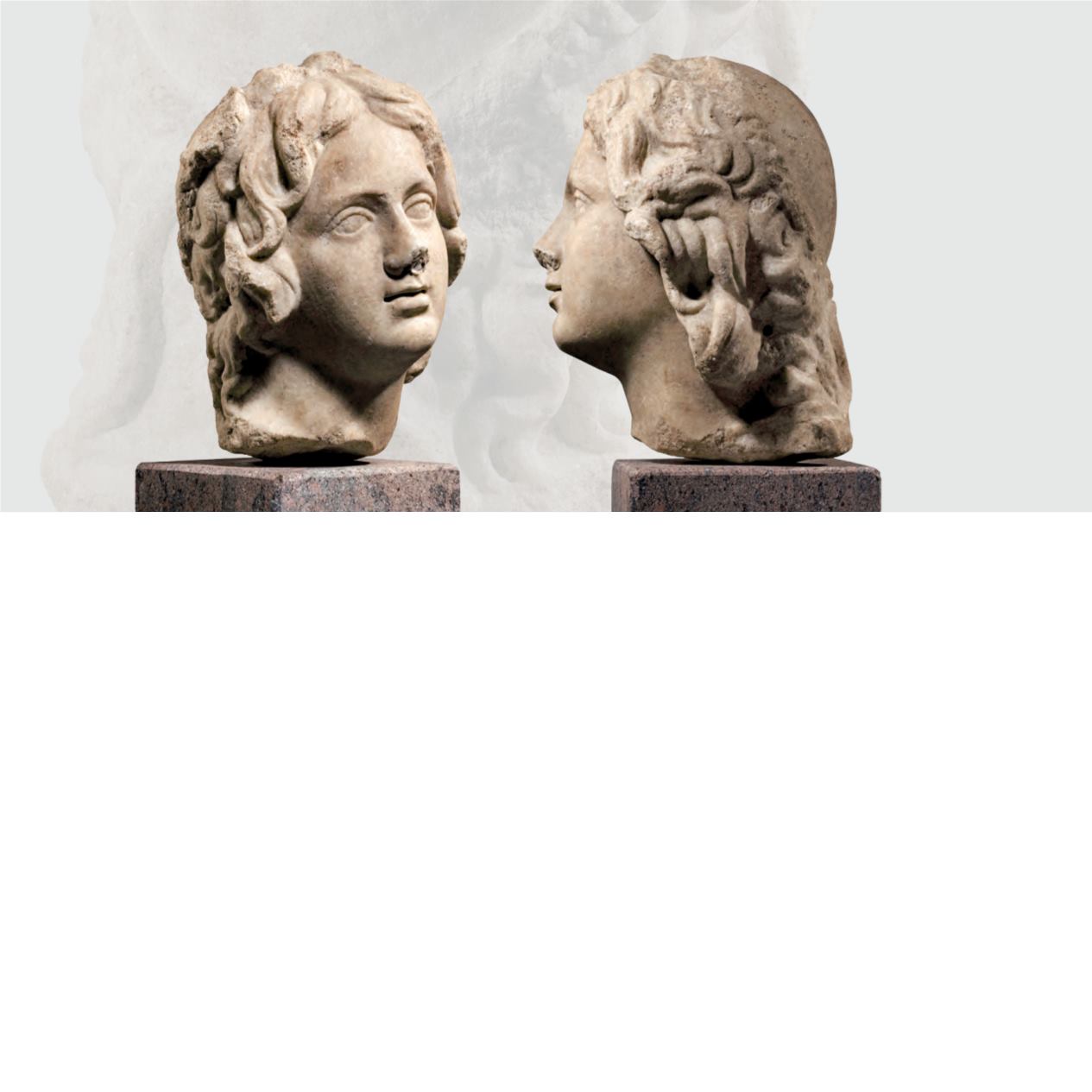
A Roman marble head of Apollo, 1st – 2nd century
Almost life-size head of Apollo with an oval face, finely carved in mar-
ble. The head inclined to the right, the eyes with thick upper eyelids,
deep perforations in the inner corners of the eyes. Exceptionally placid
expression, the mouth with full lips, slightly opened. The hair with a
centre parting, falling into thick curls over the temples at the side and
tied back with a hair band, the loop of which hangs down into the nape.
Two perforations behind the ear at the side. The posture of the head, the
lack of definition in the hair on the crown and a small chip on the left at
the top of the head suggest that the statue’s right forearm was originally
placed over the head. Therefore, a classification as Apollo Lyceus type,
modelled after Praxiteles in the 4th century B.C., would appear highly
likely. Mounted on a pedestal. Small restorations to the upper lip, the
left eyebrow and the left cheek. The tip of the nose knocked. Overall,
a head of Apollo in superior quality. Height 26 cm, including pedestal
38 cm.
Proven ance:
Private Austrian collection, previously in a private Swiss
collection, acquired in 1978. Subsequently in an English auction house.
246853
II -
€ 15.000
RÖMISCHES REICH
3075
Marmorkopf des Apollo, römisch, 1. - 2. Jhdt.
Fein gearbeiteter, annähernd lebensgroßer Marmorkopf Apollons mit
ovalem Gesicht. Der Kopf zur rechten Seite geneigt, die Augen mit
dicken Oberlidern, in den inneren Augenwinkeln tief gebohrt. Der
Ausdruck von besonderem Sanftmut, der Mund mit seinen vollen Lip-
pen leicht geöffnet. Das in der Mitte gescheitelte Haar fällt in dicken
Locken seitlich über die Schläfe und wird oben von einem Haarband
zusammengebunden, das als gebundene Masche in den Nacken fällt.
Seitlich hinter demOhr zwei Bohrungen. Die Art der Kopfhaltung, die
fehlende Verarbeitung der Haare an der Kalotte und ein kleiner Aus-
bruch oben links am Kopf könnten darauf hindeuten, dass der rechte
Arm der Statue einst über den Kopf gelegt war. Eine Zuordnung als
Apollon Lyceus, nach dem Vorbild des Praxiteles aus dem 4. Jhdt. v.
Chr. erscheint daher als sehr wahrscheinlich. Gesockelt. An der Unter-
lippe, der linken Braue und der linken Wange kleine Restaurierungen.
Nasenspitze bestoßen. Insgesamt jedoch ein Apollo-Kopf von vorzüg-
licher Qualität. Höhe 26 cm, mit Sockel 38 cm.
Provenienz: Aus österreichischer Privatsammlung, vormals Schwei-
zer Privatsammlung, erworben 1978. Danach in einem englischen Auk-
tionshaus.