


 44 / 946

3046
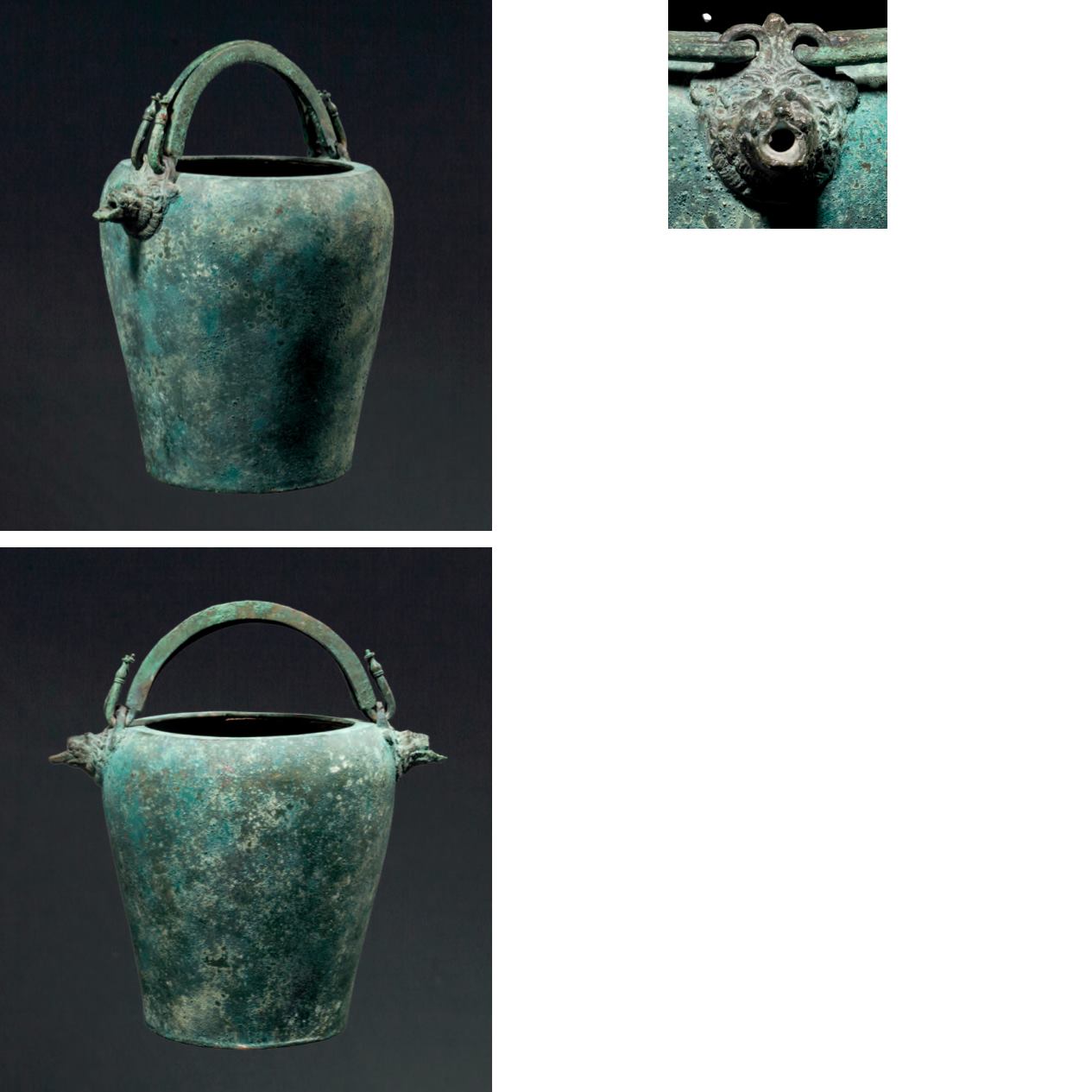
Bronzesitula, griechisch, 4. Jhdt. v. Chr.
Birnenförmige Situla aus getriebenem Bronzeblech mit flacher, mittig
nach innen gezogener Basis mit konzentrischen Kreisen, die vom Ab-
drehen auf der Drehbank herrühren. Der deutlich stärkere Rand hori-
zontal nach innen gezogen. Doppelwandige Konstruktion, die der Ge-
fäßwand eine ungewöhnliche Dicke verleiht. Unter dem äußeren Rand
die Kanten des dem Außenverlauf folgenden Einsatzes erkennbar. An
der Schulter sitzen zwei äußerst fein gearbeitete Attaschen in Form von
Löwenköpfen mit weit aufgerissenem Maul und prachtvoller Mähne.
Die Attaschen haben jeweils die Funktion eines Ausgusses, wobei auf
der einen Seite fünf kreisrunde Lochungen, auf der anderen eine of-
fene und drei geschlossene Lochungen vorliegen. An den Attaschen
setzen auch die beiden halbkreisförmigen Bügelhenkel mit mehrfach
profilierten Enden an. Der Rand oben flach, damit die Henkel gera-
de aufliegen. Zu diesem Situlentyp Vgl. S. Boucher, Bronzes grecs,
hellénistiques et étrusques, Lyon, 1970, S. 132 ff., Nr. 140. Oberfläche
mit bläulich-grüner Patina und zahlreichen Cupritspuren. Seltenes,
vor allem hervorragend erhaltenes Bronzegefäß. Intakt. Dimensionen
22,5 cm x 27,7 cm.
Provenienz: Aus österreichischem Kunsthandel, davor deutsche Pri-
vatsammlung, erworben in den 1980er Jahren.
A Greek bronze situla, 4th century B.C.
The pear-shaped situla made of hammered sheet bronze with a flat base,
drawn inwards in the centre, with concentric circles, caused by twisting
it off the lathe. The considerably projected edge is rolled inwards ho-
rizontally. Double-walled construction, rendering the vessel wall un-
usually thick. The edges of the insert discernible below the outer rim
where it follows the external contours. At the shoulder, two extremely
elaborate attachments in the shape of lion’s heads, their mouths wide
open, with magnificent manes. Both attachments also serve as spouts,
whereby one side has five circular perforations, while the other has one
open and three closed perforations. The two semi-circular loop handles
with multiple grooved ends are also joined to the attachments. The rim
flat at the top so that the handles lie straight. With regard to this situla
type, cf. S. Boucher, Bronzes grecs, hellénistiques et étrusques, Lyons,
1970, p. 132 ff., no. 140. The surface with a bluish-green patina and
numerous traces of cuprite. Rare bronze vessel, in an outstanding state
of preservation. Intact. Dimensions 22.5 cm x 27.7 cm.
P
rovenance
:
From the Austrian art market, before that in a private
German collection, acquired during the 1980s.
246850
II -
€ 15.000
42
|