


 109 / 946

|
107
chon in the centre, its edge mount slightly broken away underneath. A
softly notched border of spirals carved on the outside. The inside ador-
ned with interlaced squares, separated by lines. A rivet in front of the
cabochons in each of the corners to attach the buckle to the belt. The
eagle’s neck with reticular notching, forming rows of lozenges. The eye
pierced, before which an additional rivet to attach it to the belt. A U-
shaped bracket with a slit soldered onto the front end, connecting the
pin and frame to the appliqué plate. A cylindrical crosspiece riveted to
the underside of the frame, open at the back, which can be moved in the
strap. The side and front of the frame worked as a wide band, sloping
diagonally outwards, with a notched cable pattern. The bracket and the
front section of the frame each flanked by two settings soldered onto
the clasp, with pointed, spherical cabochons. The hollow-wrought pin
shaped like the stylised head of a bird of prey, the eyes also represented
by pointed, spherical cabochons. Grooves running lengthwise down the
sides of the beak, crosses on the base of the pin. A metal bridge const-
ruction attached to the metal bracket extension on the back with rivets
to clamp the belt. The majority of these crosspieces broken and loose.
Extensive remnants of the leather belt still preserved on the inside of
the bottom of the appliqué plate. Various traces of adhesive from ol-
der restoration work on the rivets and underside of the appliqué plate.
Apart from the fragmented strap construction underneath, the buckle
in outstanding condition, with slight traces of incrustation on the sur-
face. Length 15.5 cm.
Provenance:
Private Austrian collection, acquired from the stock of an
Austrian art dealer during the 1990s.
245692
II -
€ 5.000
3146
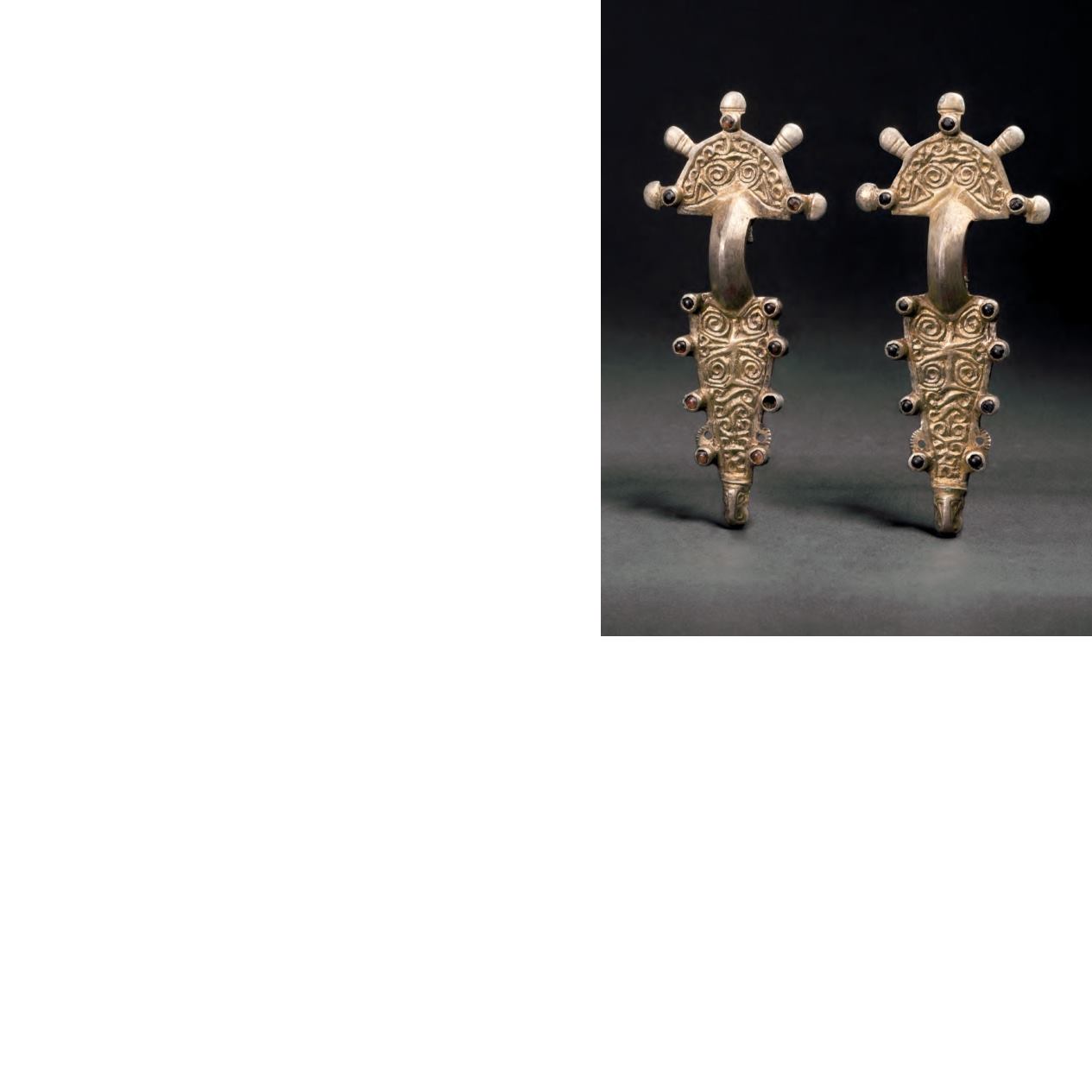
Zwei silberne Bügelfibeln, ostgermanisch, frühes 6. Jhdt.
Fibelpaar in identischer Ausführung. Halbrunde „Kopfplatte“ mit fünf
Zierknöpfen an der Außenseite, diese hinten mit zwei bis drei Kerben.
Auf dem mittleren und den zwei oberen Zierknöpfen (in Trachtlage)
durch aufgelötete Zargen eingefasste, mugelige Granatcabochons. Das
Innere der Kopfplatte mit Kerbschnitt verziert. Außen ein Zopfband,
innen zwei Spiralen zwischen drei Dreiecken. Der Bügel imQuerschnitt
dachförmig. Der Fuß langdreieckig, am oberen Ende (in Trachtlage)
durch einen stilisierten Tierkopf abgeschlossen. Außen jeweils vier
runde Zierknöpfe mit durch Zargen gefassten Granatcabochons. Die
beiden oberen stellen die Augen eines stilisierten Raubvogelkopfes
dar, dem nach unten hin die Schnäbel folgen. Im Inneren der Fußplatte
Kerbschnitt mit Binnengliederung in vier Zonen: kreuzförmig angeord-
nete Spiralen, zwei liegende S-Spiralen, zwei „hängende“ Doppelspira-
len und indifferenter Dekor im oberen Zwickel. Auf der Unterseite der
Kopfplatte Backenscharnier für die Lagerung der bronzenen Spiralach-
se, um diese gewickelt die Bronzespirale mit innerer Sehne und Nadel.
Im unteren Teil des Fußes der Nadelhalter mit U-förmig umgebogener
Nadelrast. Bei einer Fibel die obere Hälfte der Nadel abgebrochen. Auf
der Oberseite Spuren von Vergoldung. Auf der Unterseite einzelne, grü-
ne Oxydflecken. Sonst völlig intakt. Länge je 16 cm.
Provenienz: Aus österreichischer Privatsammlung, erworben in den
1990er Jahren aus den Lagerbeständen eines österreichischen Kunst-
händlers.
Two Eastern Germanic silver bow fibulae, early 6th century
Two identical fibulae. Semi-circular head plate with ornamental not-
ched carving, five decorative knobs on the outside. Three decorative
knobs set with garnet cabochons. A braided band around the edge, two
spirals between three triangles on the inside. The bow of roof-shaped
section. The long, tapering foot crowned with a stylised animal head.
Four decorative knobs set with garnet cabochons on the outer edges,
representing the eyes of a stylised bird of prey. Base plate with four seg-
ments of notched carving in a cruciform arrangement: two horizontal
S-shaped spirals and two “suspended” double spirals. The head plate
with a loop hinge for the bronze spiral axis at the bottom, the bronze
spiral coiled around it with an interior cord and pin. The foot with a
pin attachment and U-shaped, bent catch. Half of the pin broken away
on one fibula. Traces of gilding on the top, green oxide spots in places
underneath. Otherwise fully intact. Length 16 cm each.
P
rovenance
:
Private Austrian collection, acquired from the stock of
an Austrian art dealer during the 1990s.
245691
II -
€ 3.000
3146