


 34 / 946

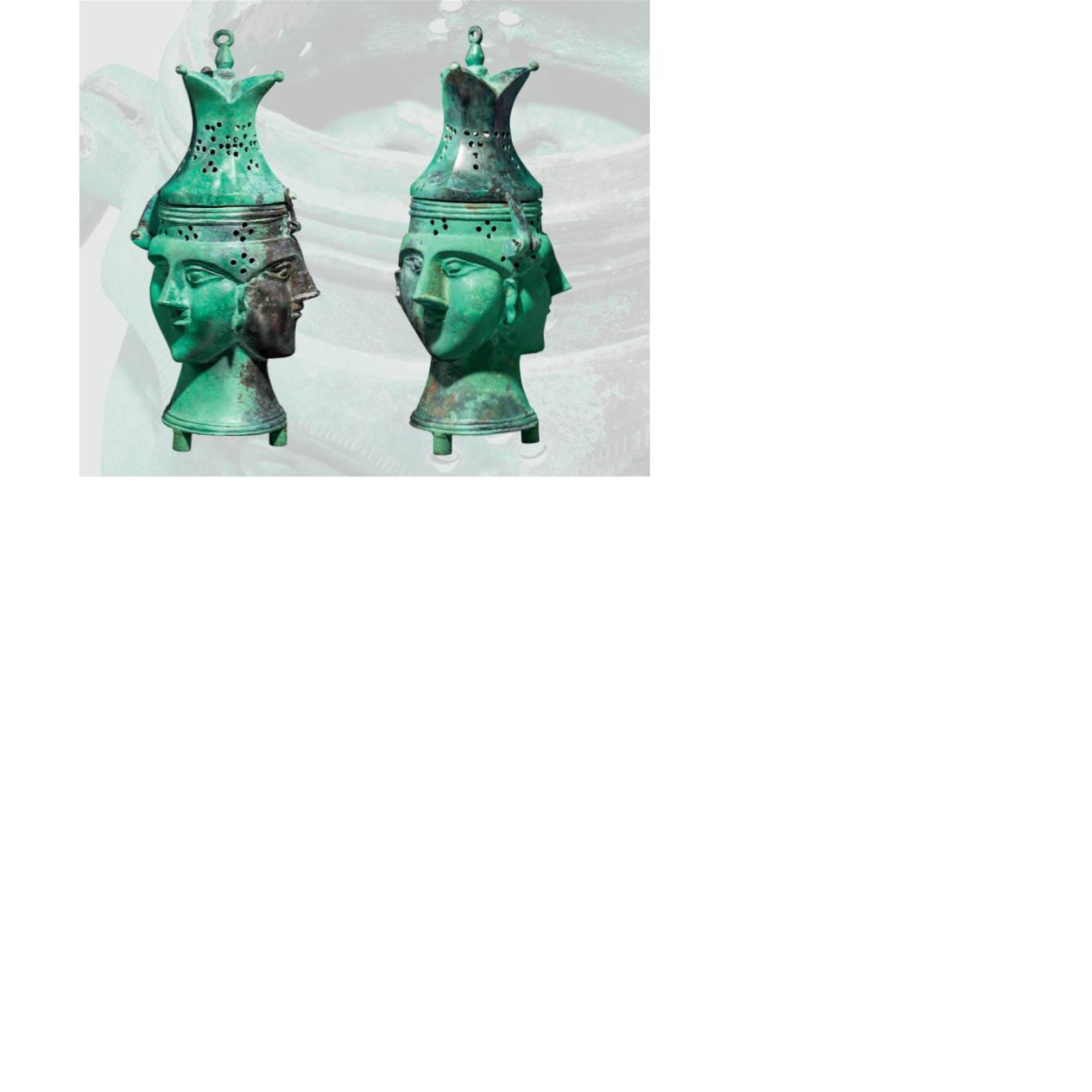
Im Backenscharnier mittels eines Stegs das
konkav verlaufende, sechskantige Oberteil
des Gefäßes beweglich befestigt. Dieses läuft
oben in drei nach außen biegende Zipfel aus.
Über diesen an einem vertikalen, profilierten
Rundstab eine Öse zumAufhängen des Räu-
chergefäßes. In den sechs konkaven Flanken
des Oberteils mittig Gruppen von Löchern
in drei unterschiedlichen Anordnungen, die
paarig aufeinander folgen. Von diesen kön-
nen zwei als stilisierte Kreuze aufgefasst wer-
den. Diese lassen das Räuchergefäß als Ob-
jekt im Spannungsfeld zwischen christlicher
(byzantinischer?) und seldschukischer Kul-
tur deuten, zwei Kulturräume die sich in den
Grenzräumen im Kunstschaffen gegenseitig
stark beeinflusst haben. Am unteren Rand
des Oberteils gegenüber dem Scharnier ein
horizontaler Stift, auf dem ein Haken aufge-
schoben ist, der das Gefäß beim Einführen
in die Öse am oberen Rand des Unterteils
verschließt. Ein Gesicht mit dunkler, umbra-
farbener Patina bedeckt, die anderen Partien
großteils mit malachitfarbener Oxydschicht
überzogen. Intakt, ohne Beschädigungen.
Ausgesprochen seltenes und ausgezeichnet
erhaltenes Räuchergefäß des mittelalterlichen
Orients, das durch seine markante Stilisierung
besticht. Höhe 25,9 cm.
Provenienz: Aus süddeutscher Privatsamm-
lung, übernommen aus altem Familienbesitz.
A Seljuq incense burner in bronze,
12th - 13th century
A three-faced body on a conical base with a
contoured edge, representing the neck. Moun-
ted on three small, cylindrical feet. The three
faces of identical design, with pointed chins
and slightly puffed cheeks. The mouths, noses
and eyes prominently shaped, with clear edges.
Short, incised lines representing the eyebrows.
An ear indicated in each of the recesses bet-
ween the three faces, above which four round
perforations, arranged in a lozenge, at the
temples. A section at the forehead is followed
by a short, cylindrical part, ending in three
surrounding bulges and completing the lower
portion of the two-tier vessel. Several lozenge-
shaped groups of circular perforations in the
flat band below the three bulges. A loop hin-
ge and an eyelet placed on opposite sides. The
concave, hexagonal upper part of the burner
can be opened and is fastened with a crosspie-
ce in the loop hinge. The upper part termina-
ting in three points curving outwards. Above
which, a loop on a vertical, contoured, round
rod to hang up the incense burner. Groups of
perforations, arranged in three different pat-
terns and following in pairs, in the centre of the
six concave side walls of the upper part. Two of
these would appear to depict stylised crosses.
Thus, the incense burner may be interpreted
as an object originating in the area of conflict
between Christian (Byzantine?) and Seljuq
cultures, two cultural spaces that had a strong
mutual influence on the artworks in the border
regions. A horizontal peg at the lower edge of
the upper part, opposite the hinge, bearing a
hook on the top, which closes the vessel once it
is inserted into the loop on the top edge of the
base. One face with a dark, umbra-coloured
patina, most of the other surfaces coated with
a malachite-coloured oxide layer. Intact, no
damage.
An extremely rare incense burner from the me-
diaeval Orient, in outstanding condition, cha-
racterised by its distinctive stylisation. Height
25.9 cm.
P
rovenance
:
From a South German private
collection, inherited from an old family estate.
239812
I -
€ 15.000
32
|
ISLAMISCHER ORIENT
3031
Seldschukisches Räuchergefäß aus
Bronze, 12. - 13. Jhdt.
Dreigesichtiger Korpus auf konischem
Unterteil mit profiliertem Rand, das den
Hals darstellt. Darunter drei zylindrische
Füßchen. Die drei gleich gestalteten Ge-
sichter mit spitzem Kinn und leicht hervor-
tretenden Wangen. Mund, Nase und Augen
markant und mit klaren Kanten ausgeformt.
Die Augenbrauen durch kurze Ritzlinien
dargestellt. In den Winkeln zwischen den
drei Gesichtern je ein Ohr angedeutet, darü-
ber auf Höhe der Schläfen vier runde Löcher,
in Rautenform angeordnet. Auf Stirnhöhe
ein Absatz, dem ein kurzer, zylindrischer
Abschnitt folgt, der in drei ringsum verlau-
fenden Wülsten endet und den unteren Teil
des zweigliedrigen Gefäßes abschließt. Im
flachen Band unter den drei Wülsten mehre-
re rautenförmig angeordnete Gruppen von
runden Löchern. An den Seiten gegenüber-
liegend ein Backenscharnier und eine Öse.